Showing posts with label Thomas K. Stevens. Show all posts

Sunday, October 15, 2023

The Tragedy of Thomas K. Stephens: A portrait of "the old reliable" miner of Idaho Springs, Colorado

Thomas K. Stephens was born into a Cornish mining family in July 1845. His father was a miner. Both his grandfathers were miners. It seemed his profession was preordained.

Despite earning a reputation as a skilled miner, the dangers of his vocation would grievously injure and maim him, and a harrowing accident would take his life.

In the beginning

When Thomas was just four years old, his family emigrated from southern England and settled in a growing mining community in Grant County, Wisconsin. As a young man, he left the area when the market for lead was no longer profitable. 

Thomas spent over a decade north of the border. First, in Nova Scotia, he married Susan Elizabeth Day in January 1868 (16 months after the birth of their first child, Thomas Jr.) and proceeded to have five children (four of whom survived infancy). Next, the family made a brief stop in Newfoundland, where their sixth child, William John Stevens (my second great-grandfather), was born in March 1879. 

By the following year, they had settled in Idaho Springs - a small mountain town that was the epicenter of Colorado's gold rush in 1859. Twenty years had passed since that first discovery of gold, but the town remained a powerful magnet luring miners eager to stake claims and strike it rich.

Idaho Springs, Colorado - c.1882-1900
Photo courtesy of Denver Public Library Special Collections

Thomas and his family's first recorded appearance in the area was the 1880 US census. They were enumerated living in his brother Richard's home. Curiously, Thomas was identified as "Maimed, Crippled, Bedridden, or otherwise disabled" in the census. Was there a mining accident in Canada that prompted the move to Colorado and convalescence in his brother's house?

Within a couple years, Thomas had amassed enough funds to buy his own place. On July 1, 1882, Thomas paid $175 for two lots on Miner Street - the town's main thoroughfare, which are illustrated on the Sanborn fire map drawn up 13 years later.

Excerpt of Thomas K. Stephens' July 1882 land indenture

Detail of 1895 Sanborn fire map for Idaho Springs
The Stephens lots were #4 and the eastern half of #5 in Block 55

Legal battle builds principled reputation

Despite The Colorado Miner's assertion in 1878 that "mining is a paying industry and not gambling," it seems there was occasional volatility that hit miners like Stephens in the pocketbook. Two years after arriving in the Rocky Mountains, a legal dispute over unpaid wages helped identify Thomas' employer. On June 29, 1882, the Georgetown Courier wrote:

"This week several of the miners employed on the Hukill mine have quit work and placed their accounts in the hands of attorneys for collection. It seems the company is behind with the miners for the months of March, April, May and the portion of June past, not having paid them a cent of wages for that length of time. Upon inquiring into the facts of the case, we find that the company is in a bad state of financial embarrassment, and unless a large sum of ready money is forthcoming, the mine will be closed down." 

On August 25, 1882, Thomas filed a lien against the Hukill Gold and Silver Mining Company of New York, which he alleged was indebted to him for $3,032.75 "for work and labor done by me and by the assignees of the claims hereinafter specified of which claims I am the assignor, under a contract with your agent..." The lien listed the wages owed to Thomas and 30 other miners, including his eldest son Thomas H. Stephens. 

In December 1882, the court sided with Thomas and awarded him $3,116.98.

Georgetown Courier - December 7, 1882

With a court order "in favor of Thomas K. Stephens and against the goods and chattels and real estate of the Hukill Gold and Silver Mining Company", the county sheriff advertised a sale of Hukill's property "at public vendue" to satisfy Thomas' claims. Thomas had prevailed on behalf of himself and his fellow miners and burnished his reputation as a man of integrity - committed to fulfilling the employment agreements he made with dozens of men.

Plat diagram of the Hukill patent, recorded March 10, 1877

Mining just for fun

While Thomas was fighting for back payment from his previous employer, the Colorado Mining Gazette shed light on his workload and how he was making ends meet. In September 1882, they reported that the Star Tunnel site was being worked by day and night shifts and identified "Mr. T. K. Stevens (sic) is the contractor on this property." 
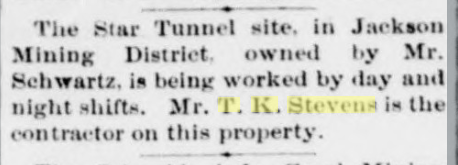
Colorado Mining Gazette - September 23, 1882

Star Tunnel site (lower middle left) - c.1890-1910
Photo courtesy of Denver Public Library Special Collections

Later that year, another dispatch noted: "Mr. Tom Stephens, the old reliable contractor exhibited to the editors of the Gazette a magnificent specimen of gold quartz just received from Nova Scotia during the last days." Apparently, he had maintained links with his Canadian sojourn. The paper also disclosed Thomas' new hobby, announcing that "he bought the Heddenburgh [mine] in Spring Gulch just for fun."

Colorado Mining Gazette - December 9, 1882

Sure enough, among Idaho Springs' land records is a deed dated December 2, 1882 documenting the $200 purchase of the mining claim known as the Heddensburg Lode in the Coral Mining district. Curiously, Thomas bought the lode with his step-father Thomas Mulcrane - the first indication that his mother, Sarah (Kitto) Stephens Mulcrane, was also in the area. 

Excerpt of Thomas K. Stephens and Thomas Mulcrane's
1882 purchase of the Heddensburg Lode

Whether much fun was ever had is uncertain. After Thomas' untimely death, the mine would continue under the operation of his son William John Stevens.

Citizenship, Incorporation, and Wrasslin

In May 1883, Thomas sold to his wife Susan their lots in Idaho Springs. She paid him $700 ($525 more than Thomas paid for the property just ten months earlier). Why was he moving their real estate in her name?

Excerpt of Thomas K. Stephens selling lots to his wife Susan

The following month, Thomas' ancestral heritage was on display. A dispatch from Idaho Springs, published in The Rocky Mountain News, named the winners of the town's Cornish wrestling match. A second place prize of $40 in gold went to Thomas Stevens. It's unclear whether this is Thomas - who was 37 years old - or his son Thomas H. Stephens who was 16. Either way, it's a rare confirmation that a popular cultural activity from their homeland (known colloquially as "wrasslin" in Cornwall, where the form of wrestling originated) was still practiced.

Rocky Mountain News - June 7, 1883

On July 6, 1883, an edition of the Weekly Register Call listed several men, including a Thomas Stevens, who "were granted first naturalization papers by Judge Collier..." Was Thomas working to become a U.S. citizen? These records aren't digitized and are archived in Clear Creek County's courthouse. I'll need to schedule a visit to learn more.

Weekly Register Call - July 6, 1883

The very next day, Thomas began advertising his mining services. T. K. Stephens & Co. were in business as mining contractors offering "Practical Mining in all its Branches" and assured clients they would "Receive Prompt Attention and Thorough Execution." The ads ran through mid-1884.

Colorado Mining Gazette - July 7, 1883

Operating his own business in a risky sector provides context and justification for why he likely applied for American citizenship and moved the family home - their largest asset - to his wife's name. 

Injury amid financial hardship

In a series of peculiar transactions in July 1884, Susan Stephens appeared to be maneuvering her family's assets to pay mounting debts. On July 12th, she mortgaged her lots on Miner Street to Bella Ward for $100. Two days later, Susan used portions of this same property as collateral in a deal with Wilber Horn who paid her $1 (at 10% interest) to satisfy a $65.36 debt on a promissory note to Dennis Faivre, an Idaho Springs grocer (who routinely advertised himself as an agent who sold Sachs, Pruden &  Co.'s famous ginger ale).  

In September 1885, Thomas suffered his first noteworthy injury. While working as a fireman in the smelter for the Plutus mine (site of the former Hukill mine), Thomas "bruised his hand" and was left "laid up". 

Colorado Mining Gazette - September 19, 1885

1890 Sanborn Fire Map, detail of Plutus mine and smelter

The extent of injury to Thomas' hand wasn't clear nor was its impact on his ability to work and earn a living. Despite an insurance policy, it appears Thomas' family continued to struggle with financial hardship. 

A testy blurb in a February 1886 edition of the Colorado Mining Gazette (in which Thomas had advertised his mining services) aired his dirty laundry for their readership: "T. K. Stevens is the name of a gentleman who poked a Gazette at the postmaster marked 'refused'. Mr. Stevens should have done this before his subscription account ran up to $350 - which he still owes at this office."

Colorado Mining Gazette - February 6, 1886

The following month brought some promising news. On March 1, 1886, Susan bought her lots on Miner Street back from Bella Ward. The Stephenses owned their home again.

Unfortunately, the danger of Thomas' work soon reemerged. During the summer, workmen at the Plutus mine were "digging trenches for the air pipe leading from the new compressor, run by water power," and huge blocks of granite were "being dressed down and laid for foundations" (Weekly Register-Call, September 17, 1886). On August 30, 1886, The Rocky Mountain News wrote of an "Accident at the Springs" that was detailed further by the Weekly Register Call:

"A deplorable accident occurred in the Plutus mine on Spanish Bar, above Idaho Springs, yesterday, to a miner named Thomas Stephens, where he had been employed for some time past, by the falling of a mass of rock weighing a couple of tons. Mr. Stevens was caught by the falling mass a little above the hips, inflicting serious injuries, which it is feared will result in death. Dr. Richmond was called from this city [Central City] to attend to the injured man, but entertains little hope for the suffering miner. 
Tom Stevens (sic) has but one hand, the right one, but notwithstanding this, he is considered one of the best miners in the county, and was always in demand by mine owners when he was out of a job. Mr. Stevens is a real estate owner and a very worthy citizen, who has the deep sympathy of every one."

Weekly Register Call - September 2, 1886

We learn for the first time that Thomas had lost his left hand - perhaps in the Plutus smelter accident nearly a year before - and was back in the mines when he was crushed by the rockfall. Despite initial speculation that his injuries would be fatal, Thomas made a rapid recovery during the fall of 1886 under the care of Dr. Richmond.

A strange fatality hovers

In June 1885, the Plutus Mining and Smelting Company of New York purchased the former Hukill mine after its assets were liquidated to pay debts owed to men like Thomas. Seven months later, in January 1886, the Plutus mine, mill, and smelter employed about 100 men and produced about $10,000 in ore each month (Rocky Mountain News, January 25, 1886). Under Plutus, profits for the mine increased $20,000 in its first six months of operation compared to the final six months under Hukill ownership (Rocky Mountain News, January 7, 1886).

Mayflower, Plutus (highlighted), and Salisbury mines along
left side and Hyland mine on right side across Clear Creek
Photo courtesy of Denver Public Library Special Collections

In October 1886, the Colorado Mining Gazette reported "Ninety-five thousand pounds of machinery arrived" for the Plutus mine. This investment included an air compressor that would "do an immense amount of hoisting, besides running fifteen three-inch air drills" (Colorado Mining Gazette, October 9, 1886). The foundations for the compressor were built during the summer, and it was during this work that Thomas was likely injured by falling rock.

Despite the improvements to the mine's operations, it remained dangerous work. On Monday, November 22, 1886, Thomas and his eldest son Thomas H. Stephens were working inside the Plutus mine when disaster struck. Shortly after 6:00 pm, an "unlooked-for and dire accident" occurred and "two men full of life and hope were hurried into eternity; one instantly and the other a few hours later."

Before he succumbed to his wounds, Thomas K. Stephens recounted the chain of events that unfolded as he and his son were setting an explosives charge to blast rock inside the Plutus mine: 

"He and his son had placed a portion of the charge of giant powder at the bottom of the hole and afterwards the fuse and cap, which was followed by more powder, which his son was in the act of pushing home with a tamper made by himself two days previously, of gas pipe with a stick in the tamping end, and thought by himself to be safe, when the explosion occurred" (Colorado Mining Gazette, November 27, 1886).

The coroner determined an inquest was unnecessary because he believed "that the men failed to push the cap and fuse home, and that when they were forcing the last part of the charge home the cap was struck by the tamping bar with sufficient force to explode it, and that if any mis-management or carelessness obtained at all, it was at that time" (Colorado Mining Gazette, November 27, 1886). Local papers ran with this assessment, writing that "T. K. Stevens made a statement a few minutes before his death, fully exonerating the Plutus management from all blame."

When the charge ignited prematurely, the resulting explosion killed the junior Stephens instantly "as he was terribly mutilated." He suffered gruesome wounds to his head, arms and torso. The senior Stephens, who was standing alongside his son, was thrown twenty feet from the stope to the bottom of the drift. He survived, was carried out of the mine and taken to his home on Miner Street where he lingered for nearly eight hours. He suffered a dislocated shoulder, broken leg, and lacerations to his body. The Rocky Mountain News wrote, "Everything was done by the medical attendants and others present to alleviate Mr. Stevens' anguished sufferings, which he bore without a murmur..." At 2:00 am, "death relieved him of his agony" (Weekly Register - Call, November 26, 1886).

The story was picked up by every newspaper in Colorado and many provided readers with graphic details of the injured. 


The Weekly Register-Call observed, "This is the second accident that has happened [to] Mr. Stevens within the past six months. The first he suffered the loss of a portion of his right hand. A strange fatality seems to have been hovering over him." The Rocky Mountain News added that, in addition to being blown up by powder twice, Thomas had "also been twice crushed by falling dirt - the last time about three months since which laid him up till about two weeks ago, when he again resumed work in the Plutus."

Weekly Register-Call, November 26, 1886

A decent interment for the dead miners

The death of Thomas and his son left Susan a widow at the age of 43 with four children to raise (her youngest was three years old and the oldest was 14). The Rocky Mountain News noted that his aged mother, Sarah (Kitto) Stephens Mulcrane, also resided in Idaho Springs.

The Stephens family pictured in the early 20th century
Susan Elizabeth (Day) Stephens is at center with her children

The Colorado Mining Gazette praised Francis Osbiston, the wife of Plutus mine manager Colonel Frank Obiston, who jumped into action and was said to be "indefatigable in her attention to the bereaved family ministering with her own hands to their wants and personally overseeing and procuring the necessary requisites for the decent interment of the dead miners."

The community rallied around the Stephens family. "Several papers have been circulating this week for the benefit of the Stevens family" that resulted in significant fundraising. "Quite a large amount has been subscribed by our citizens for the benefit of the Stevens family" with Campbell & Mason (a local grocer) leading with a $25 donation. There was even talk of organizing an "entertainment for their benefit" that the Colorado Mining Gazette urged, "Let our local talent go to work upon this matter at once. If it is delayed, people will get cold." Mayor Elliott gained the support of the city's aldermen to donate a lot in the cemetery to the family.

The remains of Thomas and his son were prepared for burial by surgeon I. N. Smith who "has one of the tenderest of hearts, and his fingers are as dexterous and careful as those of the best surgeon in the land." His skills were essential considering the grisly injuries. "He was in constant attendance upon the unfortunate Stevens family, alleviating the sufferings of the father and tenderly smoothing the face and body of the poor battered and bruised son" (The Idaho Springs News, November 26, 1886). 

During a funeral at the home, "Very appropriate and consoling remarks were made by the Rev. D. D. Van Antwerp of the Episcopal church." From the house, a "large concourse of friends and well wishers followed the remains to the cemetery, where the bodies of father and son were laid to rest side by side" (The Rocky Mountain News, November 25, 1886). 

A stone obelisk marks the Stephenses' grave. Perhaps Francis Osbiston and the community had a hand in raising funds for the tombstone. The cemetery's logs record Susan Stevens as the purchaser for the family plot. 

An inscription along the base of the stone says:

"Weep not for me oh my wife & children dear,

For I am not dead but sleeping here.

I was not yours but Christ's alone,

He loved me best and took me home."

Memorial to Thomas K. Stephens and his son Thomas H. Stephens
Idaho Springs Cemetery (photo by author)

Epilogue

After the death of her husband and son, Susan raised her four children and never remarried. She died in Idaho Springs in January 1919 having outlived six of her eight children. Her death notice flagged that "It was the express wish of Mrs. Stevens that no flowers be sent for her funeral." She was buried in the family plot and her name was added to the stone obelisk.

The Plutus continued to operate although signs of difficulty emerged. A year after the Stephenses' death, a post in the Colorado Mining Gazette said, "There is no truth in the statements...that the Plutus mine had been sold." In June 1888, the Weekly Register Call reported that two men (W. R. Ireland and John Chavanne) were killed in an explosion in the mine. In January 1891, The Colorado Miner noted "that a miner working in the Plutus mine had his hand badly crushed."

By May 1891, the Plutus mine shut down as it was reportedly "consolidating into new hands in order that it may be developed to its full extent." The Georgetown Courier added that, "When the Plutus mine shut down it had 8 inches of 259 ounce ore in the lowest level. The difficulty seems to be, not with the mine, but that the management is not harmonious. A speedy adjustment of the matter is looked for."

In February 1892, The Rocky Mountain News reported, "The Plutus mine was sold to-day by Sheriff Josiah H. Bell, for the adjustment of the claim of the judgment creditor. The First National Bank was the purchaser, the price paid being $7,422.34." Days later, the Weekly Register-Call confirmed, "A Colorado Springs Mining company has purchased the Plutus mine on Spanish Bar above Idaho Springs. The price paid was $220,000." Reflecting on its glory days, it added, "The mine is well known and at one time was very productive under the management of Col. Frank Osbiston."

During the mid-20th century, interstate 70 was built through Idaho Springs, which changed the town's appearance and obscured obvious signs of the Plutus along Clear Creek. Today, the mining industry is gone. It's easy to overlook the history of the area's mining legacy, but it's there if you're willing to dig a little beneath the surface.

Sunday, September 24, 2023

A Family History Journey to Cornwall

Sometime during the year spanning May 1849 and June 1850, a 30-year-old miner and his growing family left their home in Cornwall, England and sailed west. Henry and Sarah (Kitto) Stephens said goodbye to everything they knew in search of opportunity.

The Stephenses, my fourth great-grandparents, joined the exodus of emigrants seeking work amid southern England's 19th century economic downturn. As Cornwall's tin and copper mines declined, skilled miners like Henry sought employment overseas.

By mid-1850, Henry had found work as a miner in Grant County, Wisconsin where iron ore was in great supply. He and Sarah were enumerated in the U.S. census with their three young children - all born in Cornwall - including my third great-grandfather Thomas K. Stephens. 

They weren't entirely alone. The neighboring household included Sarah's parents - John and Mary (Wearne) Kitto - and siblings. Their migration had been a family affair.

1850 US Census excerpt detailing the Stephens and Kitto
families in Grant County, Wisconsin

Eventually, Thomas K. Stephens (also spelled Stevens) would marry, move to Colorado, and continue the mining tradition in the Rocky Mountains. It was from here that I began to uncover my Cornish roots.

This summer, I had the opportunity to travel to southern England and decided to retrace my ancestors' footsteps in Cornwall. 

Finding my ancestors' whereabouts

A friend recently toured England with her family. Before her trip, she worked with a British genealogist to identify where her ancestors had lived. The researcher found sites relevant to her family's history and produced a report that guided her journey. 

She pointed me to the Association of Genealogists and Researchers in Archives (AGRA), where I was able to filter my needs down to a researcher specializing in Cornish genealogy. This is how I was connected with the wonderful Dr. Lesley Trotter - a historian specializing in Cornish studies who shares her expertise online at Humble History.

Dr. Trotter took what I knew about my Cornish ancestry and delved deeper into my family's history, searching for locations where I could visit. That culminated in a detailed report that shaped an incredibly memorable experience.

Following my ancestors' footsteps

With Dr. Trotter's report in hand, I worked with a fantastic local guide, Becky Frost, who owns and operates Penelewey Tours, to design a tailored family history day trip.

From my hotel in Penzance, we set out for our first stop, the Church of St. Germoe in the village of Germoe. The building has Norman origins dating to 1100 AD and replaced an earlier Saxon church. 

St. Germoe

It was within these stone walls at this baptismal font pre-dating the Norman Conquest, that Henry Stephens was baptized on April 30, 1820. In fact, Henry's parents, Henry and Elizabeth (Pope) Stephens (my fifth great-grandparents), were baptized here in 1795 and 1797 respectively. 

St. Germoe's baptismal font

Henry and Elizabeth were also married here in front of this altar in July 1819. 

St. Germoe's altar

Elizabeth died in 1838 and was buried in Germoe on September 20th, although I didn't find a gravestone for her in the surrounding churchyard. 

St. Germoe churchyard with a view of the church's tower

Home Along the Beach

From Germoe, we drove to nearby Pengersick Castle as my family were likely tenants of the manor home. Today, the building is a wedding venue and I wasn't able to visit the grounds (probably due to someone's pesky nuptials taking precedence).

Next stop was a stroll along Praa Sands - a beautiful stretch of beach running alongside Prah Green, a grassy hillside where my Kitto family lived in small cottages (sadly, the originals no longer survive). The sun was warm and brought out many shades of blue in the sea. 

It was an idyllic view, yet I wondered if my ancestors had mixed feelings about living alongside the sea. Becky shared that Cornwall's winters could be dreary with gray, cold, windy, wet weather blowing off the coast.

At Praa Sands with Prah Green (site of Kitto cottages)
on the hillside

St. Breaca Church

After a pub lunch at the Lion & Lamb, we spent the afternoon at three different churches. A highlight was our visit to St. Breaca Church in the village of Breage. The current granite structure was dedicated in 1456, replacing an older Norman building. 

St. Breaca

My third great-grandfather Thomas K. Stephens was baptized here on November 21, 1845. His mother, Sarah (Kitto) Stephens, was also baptized here in February 1822. 

St. Breaca's baptismal font

Sarah Kitto married Henry Stephens before this altar on April 20, 1844.

St. Breaca's altar

During a Victorian era restoration, centuries of whitewash were removed and revealed medieval paintings survived on the church's walls. Painted over in the 16th century during the reformation of Edward VI (who ordered the destruction of idolatrous figures countrywide which included paintings and stained glass windows), the illustrations depict a number of characters who may represent St. Christopher, Christ, King Henry VI, and St. Thomas Becket.

A modern sculpture of St. Breaca with St. Christopher
painting on the wall

The churchyard included the graves for several men who shared my family surnames, including a John Kitto, William Kitto, Richard Stephens, and William Stephens (who had great real estate with his grave right outside the church's doorway). While I'm sure we're family, I don't presently know the exact relationship to these men.

John Kitto died May 12, 1865 aged 52 years


William Kitto died May 28, 1878 aged 81 years

Richard Stephens died 1834 and was a son of
William and Mary (according to a census of burials)

William Stephens died 1834 and his wife Philippa died 1838

Wheal Trewavas

The last great highlight of my family history road trip was to a site where my ancestors may have worked. Mining dominated Cornwall's economy throughout the 18th and early 19th century. Its mark still dots the Cornish landscape. Today, the ruins of engine houses (used to house the mechanics that ferried men into and out of the mine shafts and pumped out water) with their towering smokestacks are telltale signs of the area's recent history.

Near Prah Green, we hiked a trail from the Rinsey headlands that snaked along the coast atop a cliffside with breathtaking views of the sea below and on out to the distant horizon. A determined wind blew off the sea at a persistent clip. A 15-minute hike brought us to a promontory at the Trewavas headland.

From Trewavas Head looking back at Rinsey Head

Operating while my ancestors were still in Cornwall, Wheal Trewavas opened in about 1834 with men exploiting copper lodes that ran out under the sea. The mine closed in 1850 when the sea flooded the tunnels displacing a workforce of 161.

Wheal Trewavas engine house ruins

It was a moving experience to imagine my ancestors at work carving out their livings (literally). After generations of dangerous backbreaking work, it must have been heart wrenching to watch the local mining industry collapse and leave them feeling they had no choice but to emigrate. I admire the guts it took to leave everything familiar and known and move a world away to something uncertain and with no guarantee of success. 

Posing with Wheal Trewavas ruins

Their move west put them on a collision course with my other ancestral lines. They would meet, marry, and create new generations. It never ceases to boggle my mind how their decisions (some small and others big with seismic ramifications) all led to each of us existing. A different step or a choice not taken and the whole slate of history would change. 

I'm invested in learning about my ancestors' journeys - many of them arduous - that led to me and my place in the world. I'm grateful I had the privilege to visit Cornwall and gain some understanding of what their lives were like. Tremendous thanks to Dr. Trotter and Becky for their roles in making this experience happen. 

Friday, May 3, 2019

London Calling For My Cornwall Ancestors

Work brought me to London, so I added a few personal days to revel in one of my favorite cities.

Oh, and of course, delve into some family history!

London calling in search of my British ancestors

My English Roots


It was just last summer that I discovered the origins of my most recent British ancestry.

My third great-grandfather Thomas K. Stevens (spelling on his headstone in Colorado) was baptized on November 21, 1845 as Thomas Stephens in the small town of Breage in Cornwall, England (See A Felled Genealogy Brick Wall Paves the Way to Cornwall).

Thomas - who was killed in a Colorado mining accident on November 22, 1886 - was the son of Henry and Sarah (Kitto) Stephens. But who were their parents? Henry and Sarah's marriage record gave me names.

Henry was the son of another Henry and Elizabeth Stephens. Sarah was the daughter of John and Mary Kitto.

Could I learn more about my fifth great-grandparents?

RootsTech Research Pointers


Earlier this year, I attended a RootsTech presentation that featured Else Churchill, a genealogist with the Society of Genealogists in London. Since discovering Thomas Stephens' ancestral home village, I haven't spent much time researching the Stephens family line. This session equipped me with a lot of ideas on what to do when I returned to the investigation.

Else Churchell speaking at podium, RootsTech 2019

Finding myself on the other side of the pond, I decided I'd pay a visit to the Society of Genealogists in London and see what I could turn up on my recently-discovered English ancestors.

A Two Hour Search Yields New Clues


I checked in with the front desk and paid a nominal fee, affording me two hours of research time. After locking my bag in a locker, I found myself descending into the "lower library."

The clock was now ticking! Would I learn anything new?

Family Sleuther outside the Society of Genealogists in London.

I settled in front of a computer and began using the library's access to a handful of online databases, including Finding My Past (which I don't presently subscribe to) and the Cornwall Online Parish Clerks' database, which I have snooped in a bit.

With dedicated time focused on the Stephens, I found that the name was very popular. Not only the surname, but also the forename of my fourth and fifth great-grandfathers Henry. I took notes on all the Henry Stephens for further scrutiny at a later date when I wasn't under the pressure of the counting clock.

I soon landed on an exciting find: England's 1841 census for the town of Breage in Cornwall.

Enumerated were the households for Henry Stephens and John Kitto, my fifth great-grandfathers. In those respective households were Henry Stephens Jr and Sarah Kitto, my fourth great-grandparents.

Perhaps most exciting was the discovery that both heads of household were also miners. Their occupations were given as "copper miner." Apparently, Thomas K. Stevens carried on a tradition after immigrating to the United States as he continued in his grandfather's professional footsteps.

1841 England Census for Breage, Cornwall

The census also provided me approximate ages for my fifth great-grandfathers - information that will help guide my continued research at home. John Kitto, aged 45, was born in about 1796. Henry Stephens, aged 40, was born in about 1801. The record also confirmed both men and their households were born in the county. 

I now had time frames and geography to guide future research.

Alas, as I found this record my research time was drawing to a close. Ages and occupations: not bad for a couple hours in London.

My next visit to England will have to include a trip to Cornwall, where I can walk the footsteps of my ancestors at Land's End.

Friday, August 3, 2018

A Felled Genealogy Brick Wall Paves the Way to Cornwall

Over four years ago I wrote about my third great-grandfather Thomas K. Stevens who was killed in a grisly mining accident.

Born in England in 1845 and married in Nova Scotia in 1868, he worked in Colorado's mines until his untimely death in 1886.

I knew a fair amount about his life in North America, but who were his parents? I was at a loss.


A newspaper account reporting his death noted that he had an "aged mother who also resides" in Colorado, but she wasn't enumerated with his family in the 1880 census and, well, we all know what happened to the 1890 census. I couldn't identify a candidate who met his mother's profile.

Like his wife Susan Day, Thomas' parentage was unknown. My Stevens family line was stuck at a seemingly insurmountable brick wall yielding few clues.

My research attention turned elsewhere and the Stevens mystery sat neglected. For years. Until earlier this month...

Brotherly Love Goes Digital


While writing about my most recent immigrant ancestors, I profiled Thomas' son, my second great-grandfather, William John Stevens. Reacquainting myself with the Stevens family prompted me to reevaluate the evidence gathered. I've learned a lot in the past four years about genealogy dos and don'ts and there were a lot of very loose ends left unexplored with the Stevens line.

In 1880, Thomas' first appearance in a US Federal Census that I was aware of, showed that he and his wife Susan along with their four children were living in Idaho Springs, Colorado with his brother Richard and his wife Matilda.

1880 US Federal Census: Idaho Springs, Clear Creek, Colorado

Curiously, the census noted that Thomas was "Maimed, Crippled, Bedridden, or otherwise disabled." Had there been a mining accident in Newfoundland - where the family was last documented before Colorado - that necessitated a move to be with his family?

The census indicated Thomas was born in England as were both of his parents. His brother Richard, though, was a different story. Like Thomas, Richard's parents were both born in England. Unlike Thomas, Richard was born in Wisconsin. Aged 23 in 1880, Richard would have been born in the Badger State in about 1857.

Was I understanding this correctly: the Stevens brothers' - or at least Richard - were in Wisconsin in the mid-19th century?

Clearly, I needed to examine Richard more closely.

I quickly learned that sometime after the 1880 census, Richard and his wife Matilda left Colorado for Iowa where they appeared on that state's 1895 census. In 1902, Matilda passed away leaving Richard a widower.

Five years later, an Iowa marriage register (recently digitized) recorded the nuptials between Richard and Sarah Parish. The later-in-life wedding was quite fortuitous because Iowa began documenting the parents of both the bride and groom.

Excerpt from 1907 Iowa marriage register

Richard's second turn at love gave me his parents' names: Henry Stevens and Sarah Kitto.

These were also quite possibly Thomas' parents and my fourth great-grandparents. My only hesitation was whether either parent had died and the other remarried resulting in the brothers actually being half-siblings. But with names in hand, perhaps I could answer that question.

Tracing Family to England's Land's End


I searched Ancestry's online database of English marriages dating back to 1538, and struck gold. A text-only transcription detailed a marriage between Henry Stephens and Sarah Kitto that was solemnized on April 20, 1844 in the village of Breage, Cornwall.

To my great delight, FamilySearch had digitized the parish registers, including the Stephens-Kitto wedding. After trawling through the unindexed images, I found what I was after.

Stephens-Kitto marriage in Breage, Cornwall, England April 20, 1844

The marriage record also provided the names for Henry and Sarah's fathers, my fifth great-grandfathers: Henry Stephens (Sr.) and John Kitto. The family tree was in full bloom.

Knowing that Thomas K. Stevens was born in 1845, I began paging through dozens of baptism records. At last, there he was!

My third great-grandfather Thomas Stevens/Stephens was baptized on November 21, 1845 in Breage, Cornwall. Like his brother Richard, he was the son of Henry and Sarah (Kitto) Stephens.

Thomas Stephens baptism in Breage, Cornwall, England November 21, 1845

The English marriage and baptism records were just the beginning. I now have an entire branch of my family tree rooted in Cornwall, and wonderfully comprehensive church records are helping me bring them back to life. There's plenty to keep me busy for the foreseeable future.

In the meantime, I think I'll savor this discovery. Excuse me while I binge-watch the British historical television drama Poldark, and imagine my ancestors living in the beautiful Cornish landscapes!

Saturday, July 28, 2018

A Little Desperation Goes A Long Way: Finding Susan's Parents

A week ago I was Desperately Seeking Susan's Parents.

For years I struggled to identify my third great-grandmother Susan Day's parents. I knew she was born in Nova Scotia in about 1843. Her daughter Margaret, who was the informant on her death certificate, couldn't remember Susan's mother's name and thought her father was John Day.

Was she right?

For years, the name John Day had guided and stymied my genealogical investigation into the identities of my fourth great-grandparents.


First Comes Love, Then Comes Marriage, Then Comes a Baby...


Unfortunately, Nova Scotia did not keep civil vital records in the 1840s, so I wasn't going to find a civil birth registration for Susan that would lead me to her parents.

I was fortunate to have an alternate set of records at my disposal: church registers for baptisms and marriages. Nova Scotia has a fairly robust set of digitized church records dating for some areas to the early 19th century. Perhaps I could find a marriage or baptism for Susan.

The September 18, 1866 civil birth registration for Susan's first child also included the date and location of her marriage to her husband Thomas Stevens. The date was a bit of a risque puzzlement. Was I reading it correctly?

Thomas Stevens and Susan Day marriage excerpt from birth register for son Thomas Stevens Jr.

According to this record, Thomas and Susan were married on June 21, 1866 in Halifax. Yes, you read that right. According to this birth register they were married on the summer solstice just three months before the birth of their son. Okay, so she was pregnant when they married. This is a judgment free zone!

With an exact wedding date, I should be able to find their nuptials recorded in the church register. An 1871 Canadian census told me that the family was Catholic, so I could further narrow my search to that denomination.

Disappointingly, the hunt for a wedding on June 21, 1866 came up empty-handed. I was stumped.

My efforts to locate Susan's 1840's baptism also proved fruitless. I was stalled, so I did what any good genealogy blogger would do: I wrote my way through my conundrum and shared it with the broader family history community. I posted the blog to the Nova Scotia Genealogy Facebook group where tips and recommendations immediately began to pour in.

A group member shared a pointer that would swiftly bring this brick wall tumbling down:

"I would go through these St. Mary's Basilica records page by page. Don't just look for Susan, but for the parents in case you find siblings while you look."

She was right. I knew better. I should have reviewed the entire register page by page. I foolishly let the exact marriage date on the birth register stifle what should have been a more reasonably exhaustive search.

First Comes Love, Then Comes A Baby, Then Comes Marriage


One year and four months after the birth of their son, Susan Day and Thomas Stevens were married in St. Mary's Basilica in Halifax.


They were married in the church on January 27, 1868. The marriage was not registered with the civil authorities. Perhaps they avoided that duty because their son was born out of wedlock.

Best of all, the church record yielded the information I desperately sought - Susan's parents! [Insert genealogy happy dance here]


Susan Day's parents were Robert Day and Mary Ann Warren. This information was quickly corroborated by a handful of wonderful descendants of Robert and Mary Ann (Warren) Day who had long-wondered what happened to daughter Susan (Day) Stevens.

Susan's father was Robert not John. Daughter Margaret's memory was mistaken and led me astray for years. Well, that and the fact that Thomas and Susan fibbed about the date of their marriage after having a child out of wedlock. 

But let's let bygones be bygones and revel in the discovery of my fourth great-grandparents. 

In fact, there's more good reason to celebrate. A distant cousin recently pointed me to the marriage record between Robert Day and Mary Ann Warren, which gave me the names for their parents - my fifth great-grandparents. 

In the span of a few hours, a handful of genealogists helped propel my research down the correct path, torpedoing a brick wall that gave me the names for two generations of my ancestors (that's six new direct ancestors, folks!). I now have an entire clan of people that I'm excited to get to know and quite possibly grow their pedigrees. 

Standing on the rubble of this brick wall, I can confidently say that the joy of this discovery and the new avenues of impending research was worth the years-long effort to identify Susan's parents, almost.