Showing posts with label cemetery. Show all posts

Saturday, October 14, 2017

Marking Forgotten Ancestors

As a family historian, it's unsettling when I discover that an ancestor's final resting place is an unmarked grave. 

A grave with no headstone can be misinterpreted as unimportant or insignificant. 

Of course, our ancestors amount to more than a tombstone. However, as a genealogist, I want that final piece of evidence to bookend their story. After all, we're in the business of remembering what was forgotten. 

From Start to Unceremonious End
My introduction to genealogy was researching my Italian roots. I knew nothing about that branch of my family tree. As an amateur with only the dimmest understanding of how to do good genealogy, I was proud of myself after piecing together their story. To celebrate my research victory and honor my ancestors, I went to pay my respects at their grave site.

I was excited when the cemetery office provided me a map and coordinates. Following the directions, I walked along a row of bronze markers until I came to an open patch of grass. 

My heart sank. The plot for my people was empty. There was no marker. Six feet below were people who had lived full lives (with an Italian accent), and the world above them knew nothing of their existence.

Unmarked graves of my Italian ancestors
Their unmarked graves struck me as disrespectful. Reassembling their story and bringing them back to life had become a passion project, but there was nothing there to affirm that research or acknowledge their existence. Nothing.

The 20th Century's Unmarked
There are many reasons why a headstone may not have been placed, including financial. Markers are not cheap. My second great-grandfather John (Flynn) O'Connor spent his final years living in a Catholic charitable home for the elderly, and was buried in a modern-day pauper's grave with no stone. 

I also understand that nothing lasts forever. Monuments may have been placed for our more distant ancestors and disappeared over the centuries. But ancestors who passed away in the 20th century with zero recognition? It doesn't feel right.

Reviewing my own family tree, I learned that at least eight of my direct ancestors were buried in unmarked graves, including AnnieFrankJohnMatilda, Samuel, and Wilburn

Wilburn and Annie (Winkler) Wagnon in unmarked graves on
either side of their son Wayne's marked grave

Marking Forgotten Ancestors
Fortunately, genealogists are persistent people accustomed to finding creative ways to tell their family's history. This includes marking forgotten ancestors.

Here are a couple strategies that helped bankroll markers for my ancestors.
  • In the 1990's, a collection of relatives attending our annual family reunion conducted a raffle to raise money to place headstones at the graves of two of my direct ancestors. The concept was straightforward: family donated items for a raffle. The raffle's proceeds financed markers (see Hide-and-Seek: Graveyard Edition).
  • I've recently employed a modern approach to pay for a new headstone for my fifth great-grandparents whose original markers - now over 170 years old - are broken in half and no longer bear inscriptions. Using the online fundraising site GoFundMe, I created a fundraising page where cousins could learn about the initiative and securely contribute financial support. The site creates a page that can be emailed or shared on social media. I posted it to a Facebook group for descendants of these grandparents with great success. 
What other approaches have you taken to commemorate unmarked ancestor burials? Have you had success with different fundraising strategies?

Friday, July 7, 2017

Mapping Your Ancestry: A Genealogist's Quick Guide to Google Maps

Do you ever find yourself on the road in a new city and wonder: did I have ancestors in these parts?

Last week I wrote about a road trip I made to West Virginia and how a map of ancestor burials I plotted on Google Maps reminded me of the nearby graves of my sixth great-grandparents Anthony and Margaret (Messersmith) Rosenberger.

Whether tracking burials, births, marriages, or even homesteads, Google Maps is an essential tool for the family historian. Below is an easy-to-follow 12-step process for creating your own genealogy map. Click on any of the images to enlarge them.

Step 1: Load Google Maps at https://www.maps.google.com/maps and click on "Sign In" in the upper right hand corner to log in to your google (Gmail) account.


Step 2: Click on the three horizontal bar "Menu" icon on the left hand side of the screen. This will open up the Google Maps menu.


Step 3: Select "Your Places" from the Google Maps menu.


Step 4: Click on the "Maps" option on the far right hand side of the menu.


Step 5: A new map will be created that is ready for you to personalize. Click on "Untitled map" and rename it. For example, "Ancestor Burials".


Step 6: You can also provide a description of the map. For example, "A map of all of my ancestor burials." Hit save.


Step 7: Search for a cemetery (or other location that you are plotting) and select it from the drop down menu.


Step 8: After selecting your cemetery from the search menu, click "Add to map".


Step 9: Click the pencil icon to add information about your ancestor(s) buried in the cemetery.


Step 10: After adding the names for your ancestor burials, hit save.


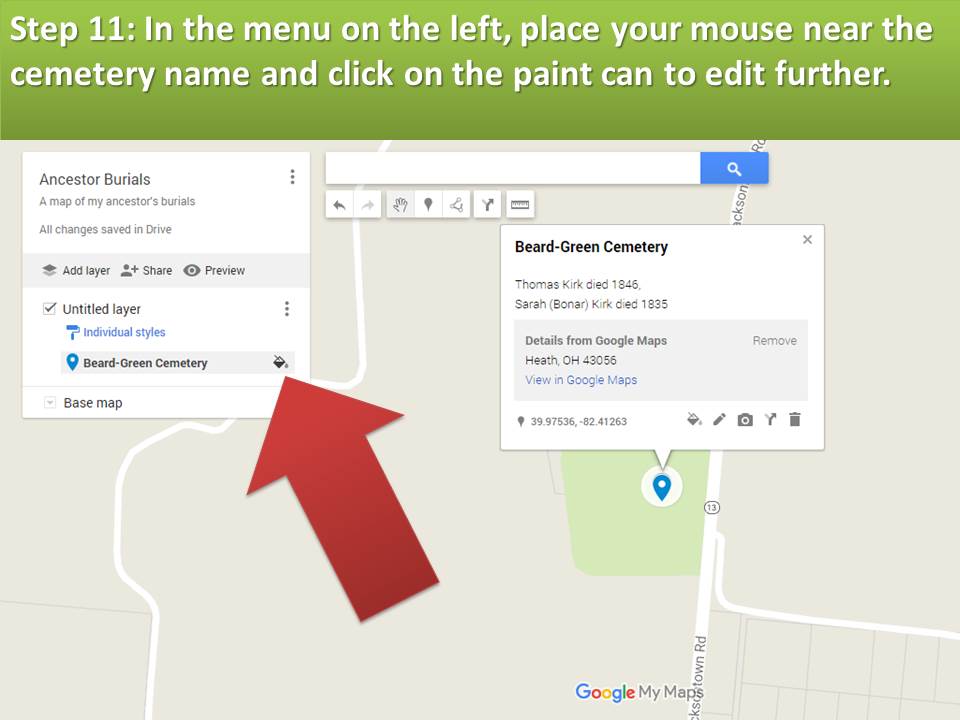
Step 11: In the menu on the left, place your mouse near the cemetery name and click on the paint can to make additional edits.


Step 12: This will open a menu that allows you to change the color or even the icon for the marker that plots the cemetery on your map. For example, I changed my icons to be a yellow flower. 


After making all edits, you're ready to add more locations to your map. Return to Step 7 and repeat the process until you've added all of your desired locations. The map saves in real time and will be in your Google Maps archive for future reference.

Happy plotting! Here's to successful family history road trips.

Sunday, July 2, 2017

Mapping Ancestor Burials: Hitting The Road And Paying Respects

I don't live near my family. Nearly 1,700 miles separate me from the Rocky Mountain home where I grew up.

However, when I put my Family Sleuther deerstalker cap on, I'm much closer to my people. True, they're not living and most of them rest eternally in the ground, but they're closer'ish.

Whether for work or leisure, I'm occasionally on the road. As a family historian, it would be a gross dereliction of duty if I overlooked my ancestors during those travels.

Using Google Maps, I've pinpointed the cemeteries where my ancestors are known to be buried. I reference this map when I'm traveling somewhere new, so I can assess just how close I may be to an opportunity to pay my respects to those that have come before me.

Ancestor burials mapped out using Google Maps

West Virginia: Wild and Wonderful
Last weekend, a quick getaway trip to West Virginia unexpectedly put me in close proximity to my sixth great-grandparents Anthony and Margaret (Messersmith) Rosenberger. They are the closest known ancestral burials to me on the East Coast.

My first stop was to Martinsburg, West Virginia. You may recall that I just wrote a blog two weeks ago about Anthony's public opposition to the presidency of Andrew Jackson. His 19th century viewpoints were only known because of their publication in the Martinsburg Gazette.

Buried in the German Lutheran Reformed Cemetery, Anthony, who passed away in 1853, rests eternally beside his second wife Nancy (not my direct ancestor). After entering the grounds through the wrought iron gate, I wandered among the markers - most of them well over a 100 years old - until I found his stone.

His headstone no longer stands upright, and the engraved text is weathered away, largely illegible. In fact, the only way to identify his stone was by comparing its shape to a copy of a photo that was taken years earlier - when the inscription was still discernible - and uploaded to Find A Grave. It helped, too, that he's buried beside his wife Nancy and her marker is still legible.

German Lutheran Reformed Cemetery, Martinsburg, West Virginia

Anthony Rosenberger (1771-1853)


Anthony's first wife and my direct ancestor, Margaret (Messersmith) Rosenberger, pre-deceased him in 1830. Her Find A Grave memorial mistakenly states that she's also buried in Martinsburg at the German Luthern Reformed Cemetery, but I discovered this is not true.

I noticed a comment online that flagged that she was actually buried about 15 miles away in the Union Church Cemetery in Middleway, West Virginia.

A short drive later and I discovered that, sadly, her headstone is one of the few no longer standing upright - just like Anthony's. I was further disappointed to discover that her stone - facing skyward - is now fractured into several pieces although largely intact. This unfortunate development must have happened since 2008 when a photo uploaded to Find A Grave showed the stone flat on the ground, but still in one piece.

Union Church Cemetery, Middleway, West Virginia

Rebecca Margaret (Messersmith) Rosenberger (1772-1830)


I count myself fortunate that I had my ancestor burial map to remind me that I had family in the area - less than 100 miles from where I live. After seeing firsthand the rapidly deteriorating condition of the stones, I'm very glad I made the visit when I did. Time is brutal to stone markers. Nothing lasts forever.

Don't you think it's time to draft your ancestor burial map and hit the open road (don't forget flowers and to upload photos to Find A Grave!)?