Showing posts with label Vachel Kirk. Show all posts

Friday, November 24, 2023

FamilyTreeDNA's Big Y-700 Uncovers Family Relationships

Genetic genealogy provided evidence that three men - all contemporaries who shared the same unusual name - were closely related to each other. But what exactly was the relationship between them?

My fourth great-grandfather was Vachel Kirk. He was born in 1805 in Ohio to Thomas and Sarah (Bonar) Kirk and lived in Licking County where he married Jane Delzell.

He was my family tree’s first Vachel. When I discovered two other men with the same peculiar name living in the same era and in generally close proximity, I had to take a closer look.
  • Vachel Kirk #2: Born in 1783 in either Ohio, Pennsylvania, or Virginia (his children couldn’t agree on a location), he married Rachel Hall. Records place him in Fayette County, Pennsylvania through 1815. Beginning in 1820, he appeared in Butler County, Ohio, where he lived the rest of his life.
  • Vachel Kirk #3: Born in about 1803 in Ohio, he married Susanna Allstaff. Records place him in eastern Ohio (Belmont, Harrison, then Morgan counties) from 1825 through 1850. In 1855, he moved to Hendricks County, Indiana where he lived the rest of his life.
Mindful of traditional naming patterns, I wondered if they were related.

Y-DNA Testing Establishes a Connection


A third great-grandson of Vachel Kirk #2 took an autosomal and Y-37 DNA test with AncestryDNA and FamilyTreeDNA respectively. The Y-DNA results indicated that he was a close genetic match to a dozen direct male descendants of Thomas Kirk, including his son Vachel. The autosomal test also surfaced more than a dozen matches with descendants of Thomas Kirk. However, the low levels of shared DNA make it difficult to pinpoint a specific family relationship with any certainty.

Encouraged by the initial matches, we upgraded the descendant’s Y-DNA test from Y-37 to Y-111 and then finally Big Y-500. At each level of higher testing, the matches with descendants of Thomas Kirk remained the closest.

In April 2023, I finally located several living direct male descendants of Vachel Kirk #3. One of the men, a descendant of Vachel’s son Isaac Kirk, agreed to a Big Y-700 test.

The results showed that he was a close Y-DNA match to all of Thomas Kirk’s descendants and the descendant of Vachel Kirk #2.

Finally, I had evidence that all three Vachel Kirks were indeed genetically related to each other.
 

Y-DNA Mutation Suggests Close Relationship


The Big Y results for the descendants of Vachel Kirk #2 and #3 suggested a particularly close relationship.

In fact, Vachel #2 and #3 are so closely related that both men belong to their own recently identified haplogroup, branching off from the haplogroup shared by Thomas Kirk and his descendants, including his son Vachel Kirk #1.

Y-DNA matches are defined by naturally yet random occurring mutations in the Y chromosome. These mutations are what allow us to distinguish Kirk men from any other man you pass on the street. They define our paternal ancestry. Men pass these mutations or haplogroup on to their sons which makes it possible for genetic genealogists to trace patterns of relatedness (source: David Vance).

Both Vachel Kirks have a newly identified Y-DNA mutation or haplogroup called R-BY100766 that is unique to them.

So why is this important and what does this reveal about my genealogy?

First, if Thomas Kirk (1778-1846) and Vachel Kirk #2 (1783-1836) were brothers (as I initially theorized), then the R-BY100766 mutation had to occur in Vachel #2 because Thomas’ descendants are negative for this haplogroup. 

However, if the R-BY100766 mutation occurred in a generation before Vachel #2 and he inherited it from his father, then he is NOT a brother to Thomas Kirk who is negative for the mutation.

Focusing on the relationship between Vachel #2 and #3, their shared R-BY100766 mutation suggests that they could be:

Father and son


Hypothetical father and son relationship for Vachel Kirk #2 and #3

Although the Y-DNA indicates it is a genetic possibility, a father and son relationship seems unlikely because Vachel #2 and his wife Rachel Hall eventually named one of their children Vachel in 1834 – over three decades after the birth of Vachel #3 (note that this child is not accounted among the three men referenced in this study). Why would Vachel #2 name two of his sons Vachel – especially if the first son of that name was still alive?

The father/son relationship theory is also undermined by the fact that Vachel #2’s future wife Rachel Hall was only 13 in 1803 when Vachel #3 was born. While not biologically impossible, it seems unlikely that she was his mother. There is currently no evidence that Vachel #2 had a relationship prior to Rachel Hall that resulted in children.

It may also be telling that there were just a dozen autosomal DNA matches between the descendants of Thomas Kirk and the descendant of Vachel Kirk #2. A previous case study examining siblingship between Thomas and Mary (Kirk) Geiger surfaced over 100 paired matches. The fewer number of matches between Thomas and Vachel #2 may be a sign that the relationship was more distant thus explaining the drop off in autosomal matches.

Because of the genealogical unlikelihood that Vachel #3 was a son of Vachel #2, it seems probable the R-BY100766 mutation was inherited from a previous generation, suggesting Vachel #2 and Thomas were not brothers.

A more likely relationship scenario is that Vachel #2 and #3 were:

Uncle and nephew


Hypothetical uncle and nephew relationship for Vachel Kirk #2 and #3

FamilyTreeDNA estimates that the most recent common ancestor of the R-BY100766 haplogroup was born around 1770 which they round down to 1750. Although not conclusive, this age approximation would fit well with the birth of Vachel #2’s father.

This would mean that the R-BY100766 mutation was inherited by Vachel #2 from his father (whose identity we don’t yet know). Vachel #2’s unknown father would then be the grandfather to Vachel #3.

In this theory, Vachel #3 would be the son of an unknown Kirk who was brother to Vachel #2.

What do you think? Does this seem possible to you?

Regardless of the scenario, to surface answers, our path forward will require more testing (both Y-DNA and autosomal). Thank goodness for Black Friday and Cyber Monday deals! 

We're getting closer to definitive answers. One cheek swab and saliva sample at a time.

Friday, May 14, 2021

Renewed Remembrance in Stone

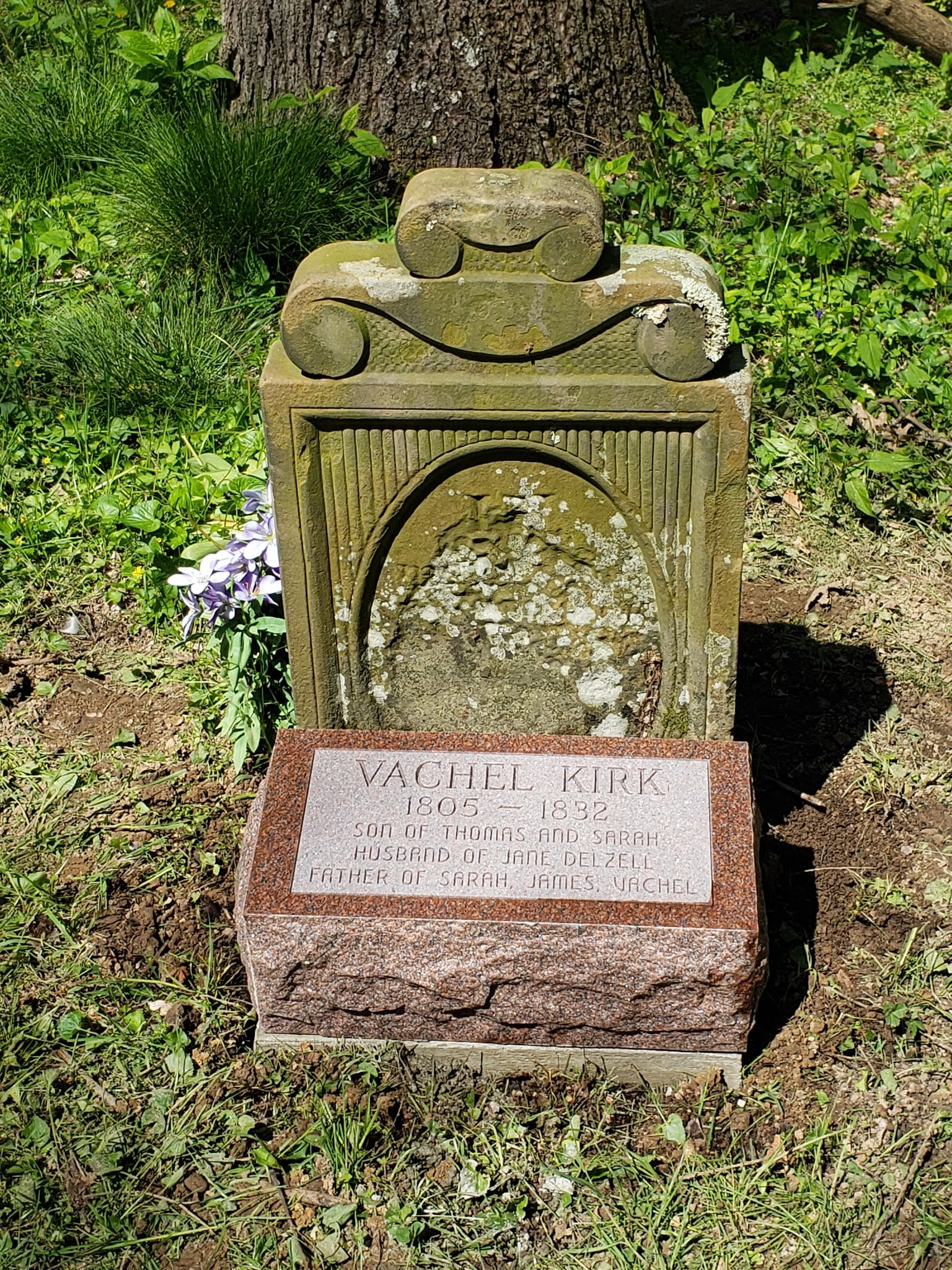
When I first visited the grave of my fourth great-grandfather Vachel Kirk (1805-1832), I was disappointed to discover that his original headstone was illegible. The marker, slanted skyward, was fully exposed to the elements. No doubt decades of snow and rain pounding at the surface completely eroded the inscription away. 

Vachel Kirk's original headstone, the inscription worn away

The only way to pinpoint the grave as Vachel's was the small footstone engraved with his initials "V.K." This marker was also beginning to succumb to damage. Pieces of the stone were flaking off around the delicate lettering.

Vachel Kirk's original footstone with the initials VK

My visit seemed fortuitous. I was able to confirm the burial location before the identifying memorials were completely destroyed. 

After having crowd-sourced a new headstone for Vachel's parents Thomas and Sarah (Bonar) Kirk (who are buried just feet away in the same cemetery on the other side of a walnut tree), I felt compelled to also preserve his memory for generations to come.

Last summer, I ordered a new headstone for Vachel. Cut from the same red Wausau granite as his parents', it was finally placed earlier this month. I took the liberty of adding some genealogical context, including his parentage, spouse and children.

Vachel Kirk's new headstone, placed in May 2021

"As long as there is one person on Earth who remembers you - it isn't over." -Oscar Hammerstein, Carousel

Have you placed a new headstone for an ancestor whose grave was unmarked or whose marker had seen better days?

Thursday, August 6, 2020

Little Old Cemetery On Our Place

Nestled in the densely forested grounds of the Dawes Arboretum is one of the oldest cemeteries in Licking County, Ohio.

The Beard-Green Cemetery is the final resting place for several of my paternal ancestors.

A historical marker details the backgrounds of the 210-year-old cemetery's namesakes, including Benjamin Green and his family who were the first legal settlers in spring 1800 of the area that would become Licking County in 1808. The marker also indicates that John Beard's family settled in 1808. 

Beard-Green Cemetery historical marker, photo by author

John Beard, who was married to Margaret Kirk, actually settled in the area at least two years prior to 1808. John was enumerated on the 1806 tax list for Fairfield County (the predecessor to Licking County), and purchased 400 acres in Licking Township, Fairfield County in January 1807. That deed indicated that John was "of Fairfield County..." and not just an out-of-towner buying up land.

But quibbles about the accuracy of the historical marker aside, the cemetery is an important place for my family history. 

John and Margaret Beard were, I believe, uncle and aunt to my fifth great-grandfather Thomas Kirk and his likely sister Mary (Kirk) Geiger - both of whom are also buried in the cemetery grounds. I believe John Beard was a father figure - if not legal guardian - for Thomas and Mary following the death of their father Joseph Kirk in Berkeley County, Virginia in about 1784. 

Missing and Deteriorating Headstones


Sadly, the passage of time has not been kind to many of the cemetery's headstones. While John Beard's marker stands prominent and majestically more than 200 years after his 1814 death, others are crumbling with weathered inscriptions or altogether missing.

Gone is the headstone for John's wife, Margaret. Presumably she was laid to rest beside her husband, but which side? There's a crumbled stone embedded in the ground to the right of John's marker (behind the flag in the picture below). However, there's no legible engraving. I've long assumed that was all that remained of Margaret's marker.

John Beard 1814 headstone, photo by author

Among the deteriorating memorials are fragments of the tombstones for my fifth great-grandparents Thomas and Sarah (Bonar) Kirk. Regrettably, the upper portion of their stones - with the invaluable biographical data - is now missing. A caretaker of the cemetery told me that many of the broken stones were buried in the northwest corner of the cemetery. 

In 2017, I worked with other Kirk descendants to lay a new headstone, which was placed between the stumps of their original headstones and commemorated their role as early settlers of Licking County.

Thomas and Sarah Kirk graves, photo by author

An exact date of death


I've long wondered what was engraved on Thomas' original tombstone. Did it provide his exact death date?

A family history published in the 1990's gave his death date as December 3, 1846, but there was no citation for where that date came from. Did it come from the tombstone?

The author of that history had visited Beard-Green and included a grainy photograph of Thomas' original headstone when it was still intact (albeit barely hanging on, clamped together by metal braces). Perhaps the stone was legible and the exact death date was pulled from the marker.


In June 1970, a local genealogy society conducted a census of burials - recording the basic bio-data that was still readable. Thomas' headstone was standing, but the information recorded was pretty basic.


Great, I had the birth and death years. I didn't want to be too greedy, but it sure would be nice to know what exactly was on the stone. Many of the markers in the cemetery give the deceased's name, exact death date and the age at death, which can then be used to calculate the birth year. 

Was that the case for Thomas?

Notes on a cemetery


During a recent visit to the genealogical society in Newark, Ohio, I landed on a new document that provided more insights. 

It was a photocopy of a notebook kept by Bertie Dawes (1872-1958), co-owner and caretaker for the surrounding Dawes grounds on which the cemetery is situated, titled, "Little Old Cemetery on our place."

The journal includes a map of burial locations (Margaret Beard was buried to the left of her husband!) and an index detailing the known burials in 1940. It also provides more of the information inscribed on each stone, including for Thomas.

In a handwritten list of burials ordered chronologically by year, Dawes recorded Thomas Kirk under 1846.


There it was in black and white. Thomas Kirk's tombstone gave his death date as December 3, 1846 at the age of 68 years, which suggested a birth year of 1778. 

This was the first time I had confirmation that the stone was the source of this information.

Although the data wasn't entirely new, Dawes' notebook provided a reference point, a citation that I could point to as corroborating evidence of Thomas' birth and death dates. That's important in any genealogy and strengthens my Kirk family history. 

Saturday, September 29, 2018

Picturing The Kirk Family's Westward Movement: Ohio to Iowa

On March 8, 1827, Vachel Kirk and Jane Delzell married in Licking County, Ohio. The young couple - my fourth great-grandparents - started their lives together on the rugged Ohio frontier.

Licking County, Ohio Marriage Register recording nuptials of Vachel and Jane (Delzell) Kirk

Soon, the family began to grow. On February 22, 1828, Jane gave birth to a daughter named Sarah. Two years later, on January 2, 1830, the family welcomed the birth of a boy named James, my third great-grandfather.

In March 1832, tragedy struck the growing Kirk family. Vachel died when he was just 26 years old, leaving his young widow - who was four months pregnant - alone to raise their family.

Less than four months later, on August 16, 1832, Jane - now a single mother - gave birth to a son named Vachel Jr. in honor of the family's recently departed patriarch.

Probate Settlement and Resettlement in Iowa 


The settlement of Vachel's estate dragged on for several years. Finally, on April 11, 1835, the proceedings of the Licking County Court of Common Pleas awarded legal guardianship of the three Kirk children to their mother Jane.

Jane Kirk awarded guardianship, Licking County Court of Common Pleas 1835

During her widowhood, Jane (Delzell) Kirk was one of those rare examples of a woman appearing on a pre-1850 census by name because she was now the de facto head of household. The 1840 US Federal Census gives a sense that, although she was a single mother, she had the support of her family. Jane and her three children were enumerated living between her brothers Robert and James Delzell.

1840 US Federal Census, Licking County, Ohio

In the ensuing decades, the Kirk children would grow, marry, and begin families of their own in Ohio.

  • On March 3, 1847, Sarah Kirk married Francis Eaton, son of Oren Eaton who was enumerated in the 1840 census just two doors down from Jane Kirk.
  • On September 22, 1851, James Kirk married Hester Griffith.
  • On March 20, 1858, Vachel Kirk Jr. married Mahala Lawrence.

Eventually, the allure of westward expansion piqued their curiosity. That comes as no great surprise since many of Jane's late husband's siblings had already moved to Crawford County, Illinois. Her children, though, opted to move further west from Ohio to the farmlands of Iowa.

James was the first to move. An 1880-published history of Polk County, Iowa, featured a biographical sketch of his life. While in Ohio, "he learned the cooper's trade, and followed it until the spring of 1858, when he came to this county [Polk County, Iowa]."

Next up was Sarah (Kirk) Eaton's family. Years later, her obituary would recall that, "In 1865 they removed to Iowa, and in 1870 came to Leon..." Her family was enumerated in West, Montgomery County, Iowa in the 1870 US Federal Census enumeration.

In 1866, Vachel Jr's wife, Mahala, passed away in Ohio when she was about 30 years old. His obituary noted that, "Mr. Kirk then came west with his two little children, bringing his mother [Jane Delzell Kirk] with him to care for them." By 1870, he was settled in Morning Sun, Louisa County, Iowa.

With Vachel Jr.'s move, the widow Jane and her three children and their families were now all settled in Iowa.

Kirk children's location in Iowa for the 1870 US Federal Census

Picture This: 20th Century Ancestors


I'm particularly interested in the Iowa branch of my Kirk family because each of Jane's children lived well into the age of photography:


  • Sarah (Kirk) Eaton passed away on November 23, 1912 at the age of 84. She was survived by four daughters: Mrs. Emma Harvey, Mrs. Len Hamilton, Mrs. W.A. Hunt, and Mrs. Sam Rush.
  • Vachel Kirk Jr. passed away on October 13, 1916 at the age of 84. He was survived by two children: Mr. Frank Kirk and Mrs. Flora Jarvis. 
  • James Kirk passed away on August 29, 1917 at the age of 87. He was survived by four sons: William, Henry, James, and Charles Kirk; and three daughters: Mary Scovel, Jennette "Nettie" Seibert, and Bessie Clarke.


Despite living during the first part of the 20th century, I've never seen a photo of any of them.

Is there a photograph of James Kirk, my third great-grandfather, tucked away in a dusty Iowa attic? Or maybe a picture survives of one of his siblings or even their mother Jane, who passed away in 1886?

I'm putting it out into the universe and we'll see what the internet turns up. The search is on for descendants with more of the Iowa Kirk story. Stay tuned!

Sunday, October 16, 2016

What's In A Name: DNA & Naming Customs

Who was Thomas Kirk's father? A burned county courthouse, destroyed census enumerations, and lost family lore have complicated the question. Understandably, all research options are on the table as I try to uncover my fifth great-grandfather's ancestral origins.


Born in 1778 in - most likely - Virginia, Thomas settled in Licking County, Ohio where he died in 1846. Most genealogies conclude that Thomas married Sarah Louise Bonar in about 1804. Together they had at least twelve children of whom ten survived to adulthood. The eldest child was their son Vachel (my fourth great-grandfather) who was born in approximately 1805.

What can Vachel Kirk tell me about his paternal grandfather?

Traditional Naming Customs
If the Kirk family followed traditional Scottish or even Irish naming patterns, the first son was named after the father's father. Was Thomas a man of tradition? Did he name his son Vachel after his own father?

A clue to Thomas' inclinations can be found by using his eldest daughter Jane Kirk as an example. Naming customs typically stipulated that the eldest daughter be named after the mother's mother. We know that Sarah (Bonar) Kirk's mother's name was Jane (McCulloch) Bonar. It seems - at least in the case of his daughter - Thomas did stick to tradition.

Vachel certainly was an unusual name. How many could be out there? Surely I could locate them all and quickly discern whether there was any family connection to my Thomas.

Broad name research is complicated in the early 19th century census records. Only heads of household were enumerated before 1850, eliminating any Vachels who were still living with their parents. Also, many states' census records were lost, including Virginia's 1790 enumeration (this is of particular concern since some of Thomas' children indicated on later censuses that he was born in Virginia).

Ultimately, I found two other Vachel Kirks, both in Ohio, who were near contemporaries of my Thomas Kirk, although not old enough to be his father. Given the shared unusual name and location, they required further scrutiny.
Vachel Kirk from Fayette Co, PA buys
land in Knox Co, OH in November 1809.

Will Vachel Kirk Please Stand Up
Vachel Kirk #1 was born in June 1783 in Pennsylvania and died April 6, 1836 in Butler County, Ohio. His death and approximate birth dates come from his headstone. His birth location was reported by his daughter Nancy on the 1880 census.

This Vachel Kirk would have been five years younger than my Thomas Kirk. Obviously this wasn't a father son relationship. However, it's possible that they were siblings or cousins.

A Vachel Kirk was enumerated in Fayette County, Pennsylvania in the 1810 census. The eldest male enumerated in that census was between the ages of 26 and 44. If Vachel was born in 1783 he would have been 27 in 1810 and would have fit this broad age range.

In November 1809, a Vachel Kirk from Fayette County, Pennsylvania bought land in Knox County, Ohio for $100. Knox County borders Licking County to the south. This land purchase put Vachel Kirk #1 within proximity of my Thomas Kirk.

Vachel Kirk #2 is a murkier fellow. He was perhaps born in the late 1790s or early 1800s in Virginia or Ohio. There were minor discrepancies between the census records. The one common fact that helped pinpoint him was his spouse, Susanna Allstaff, and children.

This Vachel Kirk married Susanna Allstaff on December 1, 1825 in Belmont County, Ohio. To-date, his last documented appearance that I've uncovered was in the 1870 census. He was living with his wife and daughter Sarah in Clay Township, Hendricks County, Indiana. I haven't discovered a grave or other evidence of when or where he died.

Following the Genetic Code
When the paper trail doesn't cooperate, I advocate turning to the genetic code. Underscoring the value of investigating people of shared unusual family names, I've just identified a genetic link between descendants of Thomas Kirk and both of the above-mentioned Vachel Kirks. However, I still haven't determined our shared common ancestor.

I mapped out a direct male descendant of Vachel Kirk #1. He agreed to take a Y-DNA test. The results - at 37 markers - came back as a match with a genetic distance of two. Family Tree DNA estimates that, at this level, there's more than an 88% chance that we share a common ancestor within the past eight generations.

If Vachel #1 was a sibling to my Thomas Kirk, that means the common ancestor - their father - would be eight generations ago. I'm hopeful we can upgrade this Y-DNA test to include more markers and yield more refined estimates.

Meanwhile, from a different lab, a first cousin twice removed on my Kirk line recently had a new 5th to 8th cousin match appear on Ancestry. This matching cousin is a descendant of (drum roll please...) Vachel Kirk #2.

This match estimate suggests that their shared ancestor was in the range of a 4th to 7th great-grandparent. In their case, the fourth great-grandparent level begins with Thomas Kirk's parents.


It seems highly unlikely that Thomas Kirk's parents would have named two sons Vachel Kirk who both lived to adulthood, so I currently hypothesize - based largely on birth year - that one of them was a sibling to Thomas (Vachel #1) and the other was a cousin or nephew (Vachel #2). Of course, there's much more research required to confirm these theories.

I'm excited to identify new Kirk family members who were contemporaries to my Thomas Kirk. It creates new research avenues to pursue. If the records are snuffed out on Thomas' line, perhaps results for the two Vachel Kirks will help shed light on our shared paternal ancestral origins.

Sunday, July 31, 2016

Family History Emerges From The Ashes

In the early morning hours of April 3, 1875, a fire destroyed Ohio's Licking County Courthouse. A special dispatch published in the Cincinnati Daily Gazette two days later described the inferno and subsequent records loss:

"The Licking County Court-house, an ancient and notable structure, located in the center of the public park, was totally consumed by fire at an early hour this morning. The light from the cupola of the doomed building was noticeable for a considerable distance, and the scene during the season of destruction was picturesque in the extreme. The origin of the fire remains a mystery. It was first discovered in the Auditor's office, where the flames spread with such rapidity as to baffle all efforts to extinguish them. The citizens are deserving of great praise for their agility in trying to save the records of the different departments and were in a great measure successful. The records in the Probate Judge's office, including personal papers of value and fac-similes in the Prosecuting Attorney's office, with the Public Library, were wholly consumed. The records in the Recorder's, Sheriff's, and Treasurer's offices were saved with but little damage, and also those in the Auditor's office, extending back to 1865. The building was insured for $10,000." 
FamilySearch's Wiki confirms that many records were lost, corroborating the article's initial assessment of the damage. In fact, Licking County's digitized probate records on FamilySearch (and now Ancestry.com) don't begin until 1875. Decades and generations of county and family history were torched during the devastating "season of destruction."

Untimely Deaths
Thomas Kirk, my fifth great-grandfather, lived and raised his children including Vachel Kirk, my fourth great-grandfather, in Licking County. Both Vachel and Thomas had untimely deaths.

  • In either late 1831 or early 1832, Vachel died when he was about 27 years old. I have no records or family lore to explain his early passing. 
  • After Thomas' second wife passed away, her obituary casually mentioned that he was "accidentally killed" in December 1846. 

Excuse me, did you say accidentally killed?

I've already been hard on the case trying to uncover Thomas' ancestral background. He represents my Kirk brick wall. I don't know who his parents were or where they came from. As if that mystery wasn't already eating at me, now I have this eyebrow-raising, tantalizing clue suggesting his death was an untimely accident coupled with his son's passing before the age of 30.

What I wouldn't give to have some courthouse records right about now!

From the Ashes
While many records were destroyed in the fire, all sources concurred that some were salvaged. What light, if any, could the surviving records shine on my Kirk ancestors?

I contacted the Records and Archives Department at the courthouse to see what documents survived from the 1830s and 1840s. The Court of Common Pleas, which handled Licking County's probate files before 1851, has a variety of materials - not indexed, not microfilmed, not digitized. They require someone to physically trawl through each file and docket. Fortunately, a Reference Archivist agreed to do just that! A genealogical angel!

As his search started, he began sending me updates. In the initial weeks, the Kirks didn't appear in any of the early Common Pleas Court records. The Archivist wrote, "It looks like the Kirks were good at staying out of trouble, until they died at least!" (Was it wrong for me to wish for a couple non-law-abiding ancestors?)

After a month of research, we had results! Several entries appeared in the Court of Common Pleas journals for both Vachel and Thomas Kirk. Like a phoenix from the ashes, my family history was rising.

Vachel Kirk 
On March 31, 1832, the first document for Vachel's probate package appeared in court records.

Vachel Kirk Probate: Letters of Administration 31 March 1832
Licking County Common Pleas Court Journal
According to the record, it was "Ordered that Letters of Administration on the Estate of Vachel Kirk deceased be granted to Jane Kirk (widow) and Gideon Rathbone and that they give bond and security in the sum of five hundred dollars. Thomas Kirk and John Colier security accepted by the Court. Anthony Pilzer, John [illegible] & John Parks appointed appraisers on said Estate. Bond filed & admin sworn in open court."

Another brief journal appearance for Vachel a year later in 1833: "Administrator of Vatchel [sic.] Kirk deceased allowed a further time of one year to settle up the accounts of said Estate."

Vachel Kirk Probate: Estate Settlement Period Extended
Licking County Common Pleas Court Journal

The final journal entry was dated April 11, 1835 - three years after letters of administration were first assigned to settle Vachel's estate.

Vachel Kirk Probate: Jane Kirk (widow) Appointed Guardian of Children
Licking County Common Pleas Court Journal

The record stated: "Jane Kirk appointed guardian for Sarah Kirk, James Kirk, and Vachel Kirk, children and heirs at law of Vachel Kirk deceased on her giving bond and security in the sum of one hundred dollars each and that Gideon Rathbone be accepted as security which bonds are filed duly executed and approved."

This document is fantastic. It's genealogy gold. It provides the names of Vachel and Jane's children. A month ago, I had no idea the name of their daughter. Of course, just four short weeks ago, I uncovered her name the hard way using land records among other sources (see Land Records Reveal Family and Sizable Estate). Where was this journal entry when I wanted the easy way out?!

I'm struck by the fact that Jane Kirk was appointed legal guardian for her children. Early 19th century common law removed that right, among others, from married women until they were widows. According to Bob's Genealogy Filing Cabinet, "Widows regained the rights of unmarried women during the period of their widowhood. A widow could make a will, buy or sell property, act as a guardian, sue or be sued, or be an executrix or administratrix."

Isn't it odd how legally empowering the death of a husband was for a woman?

Thomas Kirk
Only one record has been found for Thomas Kirk to-date. From an 1847 session of the Court of Common Pleas, a journal entry appoints letters of administration to settle his estate.

Thomas Kirk Probate: Letters of Administration 1847
Licking County Common Pleas Court Journal
The record stated: "Thomas Kirk, late of Licking County, deceased, having died intestate, and his widow, Anna Kirk, having relinquished her right to administer in favor of James Kirk, it is on motion ordered that letters of administration issue to the said James Kirk, who accepted said trust, and gave bond conditioned according to law, in the final sum of $400, with Thomas Kirk [Jr.] and Daniel Kirk, as securities; which bond is approved by the Court. Ordered that James Johnston, George Aubert and Hugh Ford appraise the personal estate of said intestate."

On first review, without any further research, this entry tells me that Thomas died without a will, and that his son James was appointed estate administrator. What is the relationship of the other people named in the record to Thomas? I need to investigate these relationships in case there are any clues to my brick wall questions.

Documents In Hand, But Answers Remain Elusive
While the Archivist has several other sources he plans to investigate, these initial documents have not provided answers to the fundamental question of how these two men died. Nor have they answered who Thomas' parents were. That's okay. I wasn't expecting to find the smoking gun. With few records on Thomas and Vachel Kirk in existence, I'm absolutely thrilled that anything survived the 1875 courthouse blaze.

Let that be a lesson to you to connect with multiple offices of the courthouse to make sure records haven't been overlooked or stored elsewhere. You never know what's been tucked away for safekeeping and, eventually, forgotten.

Now, how do I prompt FamilySearch to send out a team to photograph and digitize all of these records?

Saturday, July 2, 2016

Land Records Reveal Family and Sizable Estate

Land records can be a treasure trove for genealogy. Take for example two transactions for property once belonging to my 5th great-grandfather Thomas Kirk. These deed transfers identified a lost great-aunt and revealed the size of Thomas' estate at the time he died in 1846.

Land Records
Readers of this blog know that I am trying to learn who Thomas Kirk's parents were. It's been an arduous ordeal due to spotty record keeping and burned courthouses.

As I examine all existent record sets, I've come to one last area of focus - the land records held in the Licking County Recorder's Office. I am baffled as to how these survived when all other courthouse records - marriages, probates, etc. - went up in smoke. But I am grateful that anything remains.

About a month ago, I submitted a very broad request for all land records mentioning Thomas Kirk. A kindly clerk in the office indulged me and took the time to entertain my unfocused request. She returned copies of a handful of land records. Many were not for my Thomas, but two were gems.

Land Transaction #1
On May 11, 1848, two of Thomas' sons, William and Thomas Jr., along with their wives sold 33 acres of land in Monroe Township, Licking County, Ohio for $310 to a William Gossage.

What's particularly exciting about this record is that it infers they inherited the land from their deceased father Thomas. "Know all men by these presents that we William Kirk and Nancy his wife, Thomas Kirk and Hester his wife heirs at law of Thomas Kirk deceased of the County of Licking and State of Ohio..."


Thomas' last known location - as enumerated in the 1840 census - was in Monroe Township. It appears - as heirs at law - that his sons have inherited some of his property in Monroe Township following his death in 1846 and are selling their stake.

Land Transaction #2
The next genealogy gem came by happenstance. On the second page of the above-mentioned land transaction, there were the beginnings of a new transaction. The Licking County clerk had crossed it out since it was separate and seemingly unrelated to the record involving Thomas' sons.

I casually glanced at the record, which outlined the sale of 5 1/2 acres of land in Monroe Township on May 12, 1848 by Francis X. Eaton to the very same William Gossage. Recognizing the same name and township, I read the record more closely. "Know all men by these presents, that we Francis X. Eaton and Sarah wife of said Francis X. Eaton heirs at law of Thomas Kirk deceased of the County of Licking and State of Ohio..."


Now wait just a minute! Who were Francis and Sarah Eaton that were also heirs of the deceased Thomas Kirk and selling what appeared to be inherited property?

Who Was Sarah Eaton?
I searched the census records for Licking County and found a Francis X. Eaton in the 1850 census with a Sarah (presumably his wife). Sarah was born in Ohio and her age was enumerated as 22 years old, suggesting she was born in approximately 1828. She was born too late to realistically be a daughter of Thomas' wife Sarah Bonar who would have been about 44 years old at that time.

I traced Sarah and Francis Eaton through decades of census enumerations, following their move from Ohio to Iowa. In the 1880 census, their relationship as husband and wife was confirmed.

From 1850 to her final enumeration in 1910, Sarah Eaton's census appearances revealed she and her father were born in Ohio and her mother was born in Pennsylvania.


A brief synopsis of her death certificate (on FamilySearch.org), showed that Sarah Eaton died November 23, 1912 in Des Moines. A burial index indicated she was buried in Leon Cemetery in Decatur County, Iowa.

The real kicker came from her death certificate synopsis (also on FamilySearch.org), which provided her father's surname (not his full name, mind you. Just his surname. We wouldn't want to make this too easy!): Kirk.

Sarah (Kirk) Eaton death record synopsis from FamilySearch.org

Of course, I plan to order her death certificate from Iowa to see if the parents' full names are included. But in the meantime I turned to Chronicling America to see if I could locate an obituary. Sure enough, I did!

Disappointingly, it didn't mention her parents names. However, it provided a clue that helped me resolve the mystery of Sarah and position her on the appropriate branch of the Kirk family tree. The link was confirmed thanks to the mention of her two brothers.

Sarah (Kirk) Eaton obituary, Leon Reporter, Iowa 28 November 1912
Thomas Kirk (1778-1846) had no children who settled in Iowa. However, his widowed daughter-in-law and her children moved to Iowa following the death of Thomas' eldest son Vachel in 1832. Vachel Kirk (born in Ohio) and Jane Delzell (born in Pennsylvania) had two sons: James (my 3rd great-grandfather) and Vachel Jr.

I knew Vachel and Jane had a daughter, but I lost track of her because she was not enumerated with her mother or brothers in the 1850 census. She either died or was married by that time. Her obituary confirmed that she married in 1847. Sarah (Kirk) Eaton born in 1828 was the lost daughter of Vachel and Jane Kirk. Land records had rediscovered my 4th great-aunt!

Thomas Kirk's Estate Wealth
It appears that following Thomas Kirk's death, each of his children received 16.5 acres of land. Sons William and Thomas Jr. collectively sold 33 acres (divide that amount by two sons and each son had 16.5 acres).

Sarah (Kirk) Eaton sold 5.5 acres. From that sale we can deduce that 16.5 acres were inherited by Vachel's three living heirs and split evenly (16.5 split between three children is 5.5).

We know Thomas Kirk had a large family - at least 9 children who survived him. Did they each inherit 16.5 acres? Unfortunately, no probate record has been found to answer this question (since it was likely destroyed by fire in the Licking County Courthouse).

But if each of his 9 children and the grandchildren of his deceased son Vachel inherited 16.5 acres, we're looking at an estate of 165 acres. A decent size for the 1840s. In 1848, each of those acres was sold for approximately 11 cents. While land was cheap, I'm sure that this was still a considerable sum for a farmer of that era.

These land records are particularly important given the scarcity of information on Thomas Kirk. They tell me two important things about him:
  1. He owned land, and 
  2. He likely owned a lot of land; enough so that his living heirs each inherited 16.5 acres.
Thomas' sizable estate and his granddaughter - my 4th great-aunt - emerged from obscurity thanks to land transactions, reinforcing the important role these records can play in genealogy, and the need to include them in a reasonably exhaustive search.

Friday, May 20, 2016

The Patriarch's Children Reveal Clues

My paternal patriarch Thomas Kirk's ancestral background is a towering brick wall. I don't know who his parents were. I don't know where he was born. I only recently determined that he was born in about 1778. His death in 1846 - just before the more informative 1850 census was conducted - has kept him veiled in an impenetrable aura of mystery.

Kirk is a relatively common surname widely found in early US census records, and can be traced back to Ireland, Scotland and England. Were Thomas Kirk and his parents part of the Scotch Irish who settled the expanding western frontier in the 18th and early 19th centuries?

Fortunately, Thomas was a prodigious family man (insert euphemism here about his virility) who had, according to family genealogies, at least 12 children with his wife Sarah Bonar. His large family left a record trail with clues about his ancestry.

Families of this size were not uncommon for the Scotch-Irish with one researcher noting that these "families tended to be large, seven to ten children per family was not unusual."1 Two sons, Andrew and George, died in infancy. All but three (Jane, Nancy, and Rachel) were boys. Earlier research indicated that there may have been a fourth daughter, Sarah, who died before adulthood. Furthermore, the 1830 census suggested there may have been yet another daughter born sometime between 1825 and 1830. The lack of information about her suggests that she also died before adulthood.


Of Thomas' 12 known children, five were alive at the time of the 1870 US Federal census. Fast forward ten years, and four of those five children were alive to contribute to the 1880 census. Another twenty years later (sure missing the 1890 census right about now!), and only two were still living to participate in the 1900 US Federal census.

These three census records were unique because they asked respondents, for the first time, to identify their parents' birth locations. The 1870 census included a box where the enumerator would add a tick mark only if the parent was foreign-born. A blank box would indicate the parent was born in America. All five children gave their father's birth location as US-based. Both the 1880 and 1900 censuses collected more specific detail by including a space to write the name of the parent's birth location.

Thomas Kirk’s Children
1870 Census
William Kirk (d. 1888)
Blank = US born
James Kirk (d. 1875)
Blank = US born
Jane (Kirk) Tracy Bottenfield (d. 1886)
Blank = US born
Joseph Kirk (d. 1901)
Blank = US born
Nancy (Kirk) Roads (d. 1907)
Blank = US born


Thomas Kirk’s Children
1880 Census
William Kirk (d. 1888)
Virginia
Jane (Kirk) Tracy Bottenfield (d. 1886)
Ireland
Joseph Kirk (d. 1901)
Virginia
Nancy (Kirk) Roads (d. 1907)
Ohio


Thomas Kirk’s Children
1900 Census
Joseph Kirk (d. 1901)
Virginia
Nancy (Kirk) Roads (d. 1907)
New Jersey

The general consensus suggested that Thomas was born in America and likely Virginia with only a few outliers (Come on, Nancy! Was it Ohio or New Jersey? One of these is not like the other!).

Daughter Jane (Kirk) Tracy Bottenfield listed Ireland in the 1880 census (contradicting her US-born response in 1870). Her Ireland response may hint at her father's ancestral origins and not necessarily his actual birth location. As one researcher wrote, "Scots-Irish in Colonial America...often described their ethnicity as simply Irish."2


The census records for his children point me to Colonial Virginia. The research effort will have to continue there. But what more - if anything - can I learn from Thomas' children, particularly mindful of a possible Scotch-Irish link?

If the Kirks followed Scottish naming conventions3, Thomas would have named his first son after his father and second son after his wife Sarah Bonar's father. We can put this to the test because we know the names of Sarah's parents: William and Jane. Thomas and Sarah's second son was named William. Custom would have also dictated that the first daughter, Jane, was named after Sarah's mother. Both align with the custom! It appears that they did follow the practice.

Thomas' first son (and my 4th great-grandfather) was Vachel Kirk. Can I infer that Vachel was the name of Thomas' father? Were there Vachel Kirks of suitable fatherhood age in the records for the time period? The search in Colonial Virginia now has a name to hunt for.

Footnotes
1 McCain, Barry. Finding the McCains: A Scots Irish Odyssey. Oxford, MS: Ulster Heritage Publishing, 2015. Page 20.
2 ibid. Page 193.
3 Traditional Naming Patterns. http://www.scotlandspeople.gov.uk/content/help/index.aspx?r=551&561