Showing posts with label Beard-Green Cemetery. Show all posts

Saturday, December 9, 2023

I Found Sarah Kirk’s Missing Footstone

I found my fifth great-grandmother Sarah (Bonar) Kirk’s missing footstone!

While researching Sarah and her husband Thomas Kirk’s genealogy in the 1990s, Donald and Theresa Kirk (4th cousins twice removed) traveled to Licking County, Ohio and photographed their graves in the Beard-Green Cemetery. At that time, both Thomas and Sarah’s headstones were already cracked in half. Thomas’ headstone had metal brackets clamping the two pieces together. Unfortunately, the upper portion of Sarah’s headstone - with her biographical information - was missing. 

Thomas and Sarah (Bonar) Kirk's graves with their original stones broken in half.
Author pictured in 2023.

Thomas Kirk's original headstone intact. 
Photographed by Donald and Theresa Kirk in the 1990s.

The upper piece of Sarah's headstone must have been missing for a long time because she wasn’t recorded in the two censuses of cemetery burials conducted in 1940 and again in 1970. Sarah, who died in 1835, was now buried in a nearly unmarked grave following decades of exposure to the elements.

Sarah’s grave would have been anonymous except for one clue. Donald and Theresa also photographed her original footstone. Her initials “S.K.” were carved in the stone and provided the only evidence that it was Sarah who was buried beside Thomas.  

Sarah (Bonar) Kirk's footstone pictured in the 1990s by Donald and Theresa Kirk.

When I made my first trip to the Beard-Green Cemetery in July 2017, I discovered that the upper portion of Thomas’ headstone and Sarah's footstone were now both missing. I searched for them without success.

During a subsequent visit to the cemetery in July 2020, I found the tip of a buried stone alongside the headstone for their son Vachel. Firmly embedded in the ground, I was unable to excavate it. I assumed I had discovered Sarah’s missing footstone. 

Vachel Kirk's original headstone with a stone buried alongside.

In spring 2021, I worked with a local monument company to place a new headstone for Vachel and asked that they dig up what I figured was Sarah’s long lost footstone. They were able to pull it out. Unfortunately, the stone was broken and no longer included the portion with initials. I thought we’d lost more of Sarah’s history.

The unearthed footstone (from alongside Vachel's headstone) was broken and didn't include the portion with initials. At first, I assumed it was Sarah (Bonar) Kirk's footstone.

That assumption was undone this past June. I made a speedy road trip to Licking County and stopped at Beard-Green to clean up the Kirk graves and place new flowers. While tidying around Vachel’s grave, I noticed the telltale signs of a stone buried behind his original headstone. 

In June 2023, I noticed a new stone emerging from behind Vachel's headstone.

I’ve been over that patch of ground countless times during my four previous visits and I've never seen any signs of a buried marker. Perhaps the landscaping crew had recently uncovered some topsoil that revealed a portion of the stone. I was able to unearth the rest of it and immediately spotted the initials “S.K.” 

I was stunned! I quickly realized that I had found Sarah’s footstone that was last seen in the 1990s. The 188-year-old stone was buried in the exact area where Donald and Theresa had photographed it 30 years ago.

I uncovered the stone that turned out to be Sarah (Bonar) Kirk's original footstone with her initials "S.K."

If that was Sarah’s footstone, it immediately raised the question of whose footstone I found in July 2020. Because of its location near the Kirk graves and that it’s made from the same type of stone and is approximately the same width as Sarah’s, I presume it’s Thomas’ original footstone. 

Sarah's newly discovered footstone (left) leaves me speculating that the other footstone belongs to Thomas Kirk.

I plan to work with a monument company to discuss preservation options and whether the markers can be safely reset. If you have experience with footstone restorations or recommendations, please share in the comments.

Friday, May 14, 2021

Renewed Remembrance in Stone

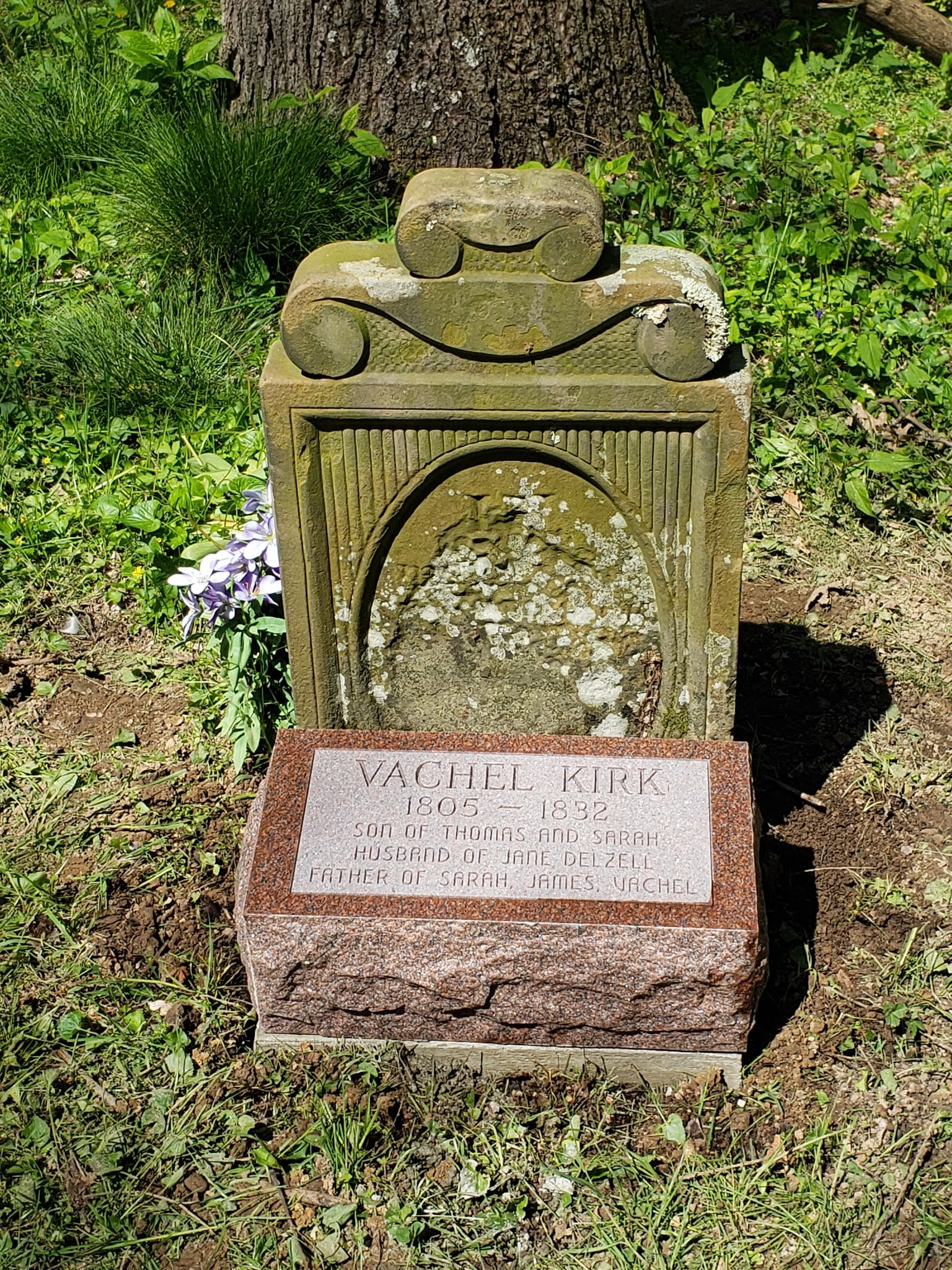
When I first visited the grave of my fourth great-grandfather Vachel Kirk (1805-1832), I was disappointed to discover that his original headstone was illegible. The marker, slanted skyward, was fully exposed to the elements. No doubt decades of snow and rain pounding at the surface completely eroded the inscription away. 

Vachel Kirk's original headstone, the inscription worn away

The only way to pinpoint the grave as Vachel's was the small footstone engraved with his initials "V.K." This marker was also beginning to succumb to damage. Pieces of the stone were flaking off around the delicate lettering.

Vachel Kirk's original footstone with the initials VK

My visit seemed fortuitous. I was able to confirm the burial location before the identifying memorials were completely destroyed. 

After having crowd-sourced a new headstone for Vachel's parents Thomas and Sarah (Bonar) Kirk (who are buried just feet away in the same cemetery on the other side of a walnut tree), I felt compelled to also preserve his memory for generations to come.

Last summer, I ordered a new headstone for Vachel. Cut from the same red Wausau granite as his parents', it was finally placed earlier this month. I took the liberty of adding some genealogical context, including his parentage, spouse and children.

Vachel Kirk's new headstone, placed in May 2021

"As long as there is one person on Earth who remembers you - it isn't over." -Oscar Hammerstein, Carousel

Have you placed a new headstone for an ancestor whose grave was unmarked or whose marker had seen better days?

Monday, October 19, 2020

Ancestors Across the Heartland - A Family History Road Trip: Part I

"Hello, Ancestors," I said aloud as I stepped into each cemetery.

Clutching bouquets of artificial flowers like dousing rods, I channeled great-grandparents of varying generations to guide me to their graves. 

At every forebear's resting place, I plunged the plastic floral offering into the earth, laid my hand on their stone, and quietly pondered their life and the American history they helped shape. 

The visits were a spiritual communion. I kept vigil for the faintest acknowledgement of my presence. Amid my contemplations, my skin would tingle with goosebumps at a sudden shift in the wind rustling the leaves or the sun cutting through clouds to cast poignant rays on cue. Broken stillness felt intentional and imbued with significance as though my presence was a touchstone conjuring the ghosts of my predecessors.

Road Tripping During The Pandemic


A cross country road trip to visit family in Colorado - who I haven't seen in over a year due to the pandemic - afforded me a rare opportunity to visit my ancestors' graves. 

Typically, I fly home to visit family. The last - and only - time I drove the 1,665 miles between my parents' Rocky Mountain home and Washington, DC was in 2004 when I embarked on my two-year east coast plan (16 years ago!).

Mapping out my route, I decided to stop at a handful of cemeteries scattershot across the United States where my kinfolk rested eternally. As a moderately tech-savvy genealogist, I pinpointed their burials on Google Maps.   

Family Sleuther's ancestors' graves

Next, I plotted a circular path that allowed me to visit different sites on my way to and from Colorado (note: the yellow flower icons are graves I've not visited and purple flowers are graves that, as of this journey, I have visited).

Journeying Through Family History


The three-week trip was a dizzying whirlwind that traced my family's history across both paternal and maternal lines not to mention time zones. Thank goodness for mobile apps like Find A Grave and Ancestry that allowed me to find everyone and reacquaint myself with their life stories on the ground and in real-time.

The numbers alone underscore the sheer magnitude of the trip.


My journey began with a visit to the Beard-Green Cemetery in Licking County, Ohio. Although I've visited before, it still holds special meaning to me as the final resting place for my fifth great-grandparents Thomas and Sarah (Bonar) Kirk and their son, my fourth great-grandfather, Vachel Kirk. 

For me, the Kirks have favored research status (yes, genealogists get to have favorite ancestors!). My fondness stems from the fact that ten years ago I didn't even know that I was a Kirk. But I did the hard work to find the connection. Confronted with whispered family rumors, I sought out DNA tests that ultimately confirmed a non-paternity event. The years of dogged research that ensued carved my path directly to these people. I worked hard to surface this family history and I gladly honor it.

All three are buried in the northwest corner of the cemetery near the edge of a dense forest. A towering walnut tree juts out from the middle of the burials - a totem that beckons me to the epicenter (and brickwall) of my Kirk paternal ancestry. After paying my respects, I turned to leave just as the sun sliced through the early morning fog and cut a path directly to the northwest corner like the dawning summer solstice sunlight finding perfect alignment among the sarsens at Stonehenge. 

Beard-Green Cemetery. Licking County, Ohio.
Thomas & Sarah Kirk and their son Vachel Kirk

As I put the car into drive, I glanced back just in time to see a fox emerge and watch me make my departure. I next drove 170 miles west to Dunreith Cemetery in rural Indiana where two sets of fifth great-grandparents are buried: Thomas and Frances (Boatright) Johnson and Philip and Sylvia (maiden name unknown) Hall. Their children, Francis Johnson and Temperance Hall, would marry and become my fourth great-grandparents. Hint: they also scored a stop on the road trip (stay tuned)!

A strong wind propelled ominously dark clouds overhead and whipped a nearby cornfield into a fury. The unyielding gusts pushed me into the cemetery grounds, firmly guiding me to their graves. They were nicely situated together. I would soon learn to appreciate the convenience of quickly locating burials in these quaintly-sized cemeteries.

Dunreith Cemetery: Thomas and Frances Johnson (foreground)
and Philip and Sylvia Hall (background), marked with flowers

My next stop was the only point where I visited non-direct ancestors. The aforementioned Thomas and Sarah Kirk had 11 children who lived to adulthood. At least seven of them settled in Crawford County, Illinois. Five of those seven - all sons - were buried in the Kirk Cemetery just north of the town of Robinson and one, a daughter, in the nearby Oblong Cemetery.

Kirk Cemetery north of Robinson, Illinois

After an overnight in Illinois, I crossed the mighty Mississippi River and cruised toward central Missouri with my first stop in Rolla. Unlike the small country cemeteries in Indiana and Ohio where I quickly found my ancestors' graves, the Rolla Cemetery is a large sprawling landscape. There was no manned office and no directory of names to provide directions, so I was forced to drive along the paved paths, back and forth, studying the engraved names. While combing the grounds, three deer nonchalantly followed at a distance and serenely eyed my frantic search. If this was a Disney movie, I would have put them to work and had them help me locate my kinfolk. Alas, they paid me little attention and continued to make salad out of the lawn.

With the afternoon sun fast approaching and encroaching on the day's second cemetery visit, I was beginning to fear that I'd driven all this way and would have to abandon the mission without finding the graves for my second great-grandmother Jelina (Williams) O'Connor Trimble (she was married, a lot!) and her parents, my third great-grandparents, Johnson and Careline (Reed) Williams. My saving grace was finding email correspondence from 2013 with a Find A Grave volunteer who first discovered the graves and took photos. In his message, saint that he is, he provided the section and plot numbers. I quickly found the graves no thanks to my animal friends.

Johnson and Careline Williams, at left, and Jelina at right.

I unexpectedly spent more time in Rolla than I originally planned. Dusk was fast approaching and threatened my chance to visit my next stop - El Dorado Springs Cemetery in Missouri - 150 miles to the west. I generously applied the gas - in the safest measure possible - to ensure a timely arrival that salvaged as much of the day's remaining sunlight as possible. Pulling into the cemetery, my heart sank to discover it was another large sprawling affair. 

Loading up the Find A Grave app, I carefully studied the photographs of the headstone for Francis and Temperance (Hall) Johnson, my fourth great-grandparents (whose parents, mentioned above, are buried in Indiana's Dunreith Cemetery), that were uploaded by a volunteer. Paying close attention to nearby headstones, trees and even a distant house, I was able to pinpoint their marker just as the sun emitted its final rays for the day.

The Johnsons share a single stone with each name carved on either side.

Francis Johnson
Temperance "Tempy" (Hall) Johnson

I made it with the last dregs of light to spare. And what marvelous light it was; a shining capstone to my travels through America's heartland. But hundreds of miles still stood between me and home. 

Stay tuned for part II of my family history road trip as I journey through Kansas' plains to Colorado's mountains. The road and ancestors call me onward! 

Thursday, August 6, 2020

Little Old Cemetery On Our Place

Nestled in the densely forested grounds of the Dawes Arboretum is one of the oldest cemeteries in Licking County, Ohio.

The Beard-Green Cemetery is the final resting place for several of my paternal ancestors.

A historical marker details the backgrounds of the 210-year-old cemetery's namesakes, including Benjamin Green and his family who were the first legal settlers in spring 1800 of the area that would become Licking County in 1808. The marker also indicates that John Beard's family settled in 1808. 

Beard-Green Cemetery historical marker, photo by author

John Beard, who was married to Margaret Kirk, actually settled in the area at least two years prior to 1808. John was enumerated on the 1806 tax list for Fairfield County (the predecessor to Licking County), and purchased 400 acres in Licking Township, Fairfield County in January 1807. That deed indicated that John was "of Fairfield County..." and not just an out-of-towner buying up land.

But quibbles about the accuracy of the historical marker aside, the cemetery is an important place for my family history. 

John and Margaret Beard were, I believe, uncle and aunt to my fifth great-grandfather Thomas Kirk and his likely sister Mary (Kirk) Geiger - both of whom are also buried in the cemetery grounds. I believe John Beard was a father figure - if not legal guardian - for Thomas and Mary following the death of their father Joseph Kirk in Berkeley County, Virginia in about 1784. 

Missing and Deteriorating Headstones


Sadly, the passage of time has not been kind to many of the cemetery's headstones. While John Beard's marker stands prominent and majestically more than 200 years after his 1814 death, others are crumbling with weathered inscriptions or altogether missing.

Gone is the headstone for John's wife, Margaret. Presumably she was laid to rest beside her husband, but which side? There's a crumbled stone embedded in the ground to the right of John's marker (behind the flag in the picture below). However, there's no legible engraving. I've long assumed that was all that remained of Margaret's marker.

John Beard 1814 headstone, photo by author

Among the deteriorating memorials are fragments of the tombstones for my fifth great-grandparents Thomas and Sarah (Bonar) Kirk. Regrettably, the upper portion of their stones - with the invaluable biographical data - is now missing. A caretaker of the cemetery told me that many of the broken stones were buried in the northwest corner of the cemetery. 

In 2017, I worked with other Kirk descendants to lay a new headstone, which was placed between the stumps of their original headstones and commemorated their role as early settlers of Licking County.

Thomas and Sarah Kirk graves, photo by author

An exact date of death


I've long wondered what was engraved on Thomas' original tombstone. Did it provide his exact death date?

A family history published in the 1990's gave his death date as December 3, 1846, but there was no citation for where that date came from. Did it come from the tombstone?

The author of that history had visited Beard-Green and included a grainy photograph of Thomas' original headstone when it was still intact (albeit barely hanging on, clamped together by metal braces). Perhaps the stone was legible and the exact death date was pulled from the marker.


In June 1970, a local genealogy society conducted a census of burials - recording the basic bio-data that was still readable. Thomas' headstone was standing, but the information recorded was pretty basic.


Great, I had the birth and death years. I didn't want to be too greedy, but it sure would be nice to know what exactly was on the stone. Many of the markers in the cemetery give the deceased's name, exact death date and the age at death, which can then be used to calculate the birth year. 

Was that the case for Thomas?

Notes on a cemetery


During a recent visit to the genealogical society in Newark, Ohio, I landed on a new document that provided more insights. 

It was a photocopy of a notebook kept by Bertie Dawes (1872-1958), co-owner and caretaker for the surrounding Dawes grounds on which the cemetery is situated, titled, "Little Old Cemetery on our place."

The journal includes a map of burial locations (Margaret Beard was buried to the left of her husband!) and an index detailing the known burials in 1940. It also provides more of the information inscribed on each stone, including for Thomas.

In a handwritten list of burials ordered chronologically by year, Dawes recorded Thomas Kirk under 1846.


There it was in black and white. Thomas Kirk's tombstone gave his death date as December 3, 1846 at the age of 68 years, which suggested a birth year of 1778. 

This was the first time I had confirmation that the stone was the source of this information.

Although the data wasn't entirely new, Dawes' notebook provided a reference point, a citation that I could point to as corroborating evidence of Thomas' birth and death dates. That's important in any genealogy and strengthens my Kirk family history. 

Saturday, September 21, 2019

The Linchpin Who Links an 18th Century Family Together

During three decades spanning 1781 to 1812 and across two states, one man repeatedly appeared in records for my Kirk family.

John Beard is the glue holding a cast of characters together, and may prove to be the key to identifying the parents for my fifth great-grandfather Thomas Kirk.

In fact, John Beard is the common denominator - the linchpin - helping me to infer family relationships among a handful of Kirks where the traditional paper trail offers no surviving evidence to confirm family bonds.

John Beard: 1753 - February 1814


A published Beard family history says John was born in 1753 in Ireland, married a woman named Margaret Kirk, and died in February 1814 in Licking County, Ohio. He was buried in the Beard-Green Cemetery in Licking County, Ohio.

John Beard grave, Beard-Green Cemetery, Licking County, Ohio
(photo by author)

In an application to join the Daughters of the American Revolution that was submitted by Cora Beard Williams - a great-granddaughter of John Beard - she stated that John married Margaret Kirk who was born April 12, 1758 and died July 7, 1850. Some Beard family histories suggest that she, like John, was also born in Ireland.

Sadly, Margaret's headstone is no longer standing. I presume it is the crumbled heap of stone beside John's memorial.

Likely remains of Margaret (Kirk) Beard's headstone, Beard-Green Cemetery,
Licking County, Ohio (photo by author)

In 1970, the Johnstown Genealogy Society conducted a census of the Beard-Green Cemetery and recorded the most basic bio-data from the memorials still surviving in that year. Fortunately, Margaret's headstone was still upright and legible. Her marker once indicated that she was born in 1758 and died in 1850 and was the wife of John Beard.

Excerpt of Beard-Green Cemetery headstone inscriptions, highlighting
John and Margaret (Kirk) Beard

Margaret's relationship, if any, to my Kirk family is unknown.

Aside from the curious shared surname between my kin and Margaret's maiden name, the Beard-Green Cemetery is an important beginning to the role John Beard played in the lives of my Kirk family. Just yards from John's burial is the grave for my fifth great-grandfather Thomas Kirk (1778-1846).

John's eternal resting place is also near Mary (Kirk) Geiger (1774-1832) - a woman who I speculate was the older sister to my Thomas. Unfortunately, her headstone no longer survives. However, thanks again to the dedicated efforts of the Johnstown Genealogy Society, I know that in 1970 her memorial was still upright and indicated that she was born in 1774, died in 1832, and was the wife of Anthony Geiger.

Excerpt of Beard-Green Cemetery headstone inscriptions, highlighting
Mary (Kirk) Geiger

The paper trail links John with both Thomas and Mary.

John Beard in the Records


I first heard of John Beard when I found a land deed for my Thomas Kirk. In January 1812, Thomas purchased 100 acres in Licking County from John and Margaret Beard.

Thomas Kirk buys land from John and Margaret Beard - January 25, 1812

After discovering the record, I didn't think much of John Beard and carried on merrily with my research narrowly focused on Thomas.

It wasn't until some years later, when a fellow blogger and descendant of another 19th century Licking County resident, Mary (Kirk) Geiger, turned me on to the possibility that Mary and Thomas were siblings, that I happened upon the Beard name again.

Researching Mary Kirk, I discovered that she and her husband, Anthony Geiger, had married in Berkeley County, Virginia (now West Virginia).

A marriage bond, dated September 1797, was signed between Anthony Geiger and [drum roll, please] ... John Beard.

Anthony Geiger and Mary Kirk 1797 marriage bond with John Beard as surety

A review of Berkeley County land records confirmed that there was indeed a John and Margaret Beard living in the area. In June 1786, "John Beard and Margaret his wife" sold 25 acres to a William Roberson.

John and Margaret Beard sell land in Berkeley County, Virginia - June 1786

With a John Beard now affiliated with both Thomas Kirk and his alleged sister Mary (Kirk) Geiger, and all three buried in the same small Ohio cemetery, I continued to dig into Berkeley County records.

Geiger family histories stated - without corroborating evidence - that Mary Kirk was the daughter of Joseph and Sarah Kirk.

Fortunately, land and tax records confirmed that there was a Joseph and Sarah Kirk in Berkeley County.

In 1781, Joseph Kirk was required - like all area farmers - to provide grain to Virginia's Continental troops in support of the Revolutionary War effort.

Joseph Kirk received a certificate detailing his contribution. The certificate, numbered 486, was Joseph's receipt which he could use for later reimbursement with the government.

1781 Public Service War Claim for Joseph Kirk, #486

The certificates appeared to have been issued in the sequential order that they were received from area farmers. Certificate number 487? It belonged to [drum roll, please] ... John Beard.

1781 Public Service War Claim for John Beard, #487

Did Joseph Kirk and John Beard go to submit their war claims together? Perhaps it's a faint hint that there was in fact a relationship between the two men.

By 1784, it appears that Joseph Kirk was gravely ill or had died. The Kirks were hauled into court for falling behind in payments on their leased farm. Sarah Kirk was called into court. Joseph didn't accompany her. Instead, she was represented with, you guessed it, John Beard.

1784 Replevy Bond - Fairfax vs. Sarah Kirk and John Beard

A Theory


With John Beard's reoccurring appearances in the Kirk family records, I'm reminded of Elizabeth Shown Mill's recent admonishment that anyone connected to our family is someone we need to get to know well.

Could all of John Beard's appearances be a coincidence? Sure, of course.

But I suspect there's something more at play. John's multiple appearances have helped me stitch together this theory:


  • Perhaps Thomas Kirk and Mary (Kirk) Geiger were siblings. 
  • Maybe their parents were Joseph and Sarah Kirk. 
  • Maybe Joseph died when both of his children were still minors, and John Beard stepped in to play the role of male guardian. 


Why would John do such a thing? Perhaps he was compelled to look after his family. Was John's wife, Margaret Kirk, a sister to Joseph Kirk thus linking the Beards and Kirks?

Although documentary proof has yet to surface, there's certainly enough here to chew on and ponder. What do you think? Is there anything to this notion?

Sunday, December 3, 2017

Honoring The Patriarch in Stone

When she passed away in early 1879, Annie (Bailey) Gilliland-Kirk's obituary revealed an intriguing clue about her second husband:

 "... in 1837 she became the wife of Thomas Kirk, with whom she lived until ... he was accidentally killed."

I'm sorry, say what? Accidentally killed?

That's it. The obituary doesn't elaborate on my fifth great-grandfather's passing. No other documentation survives - not even family lore - to hint at the circumstances of Thomas' accidental end.

There's just that brief line to leave his descendants in tormented wonder.

Marked in Stone
Thomas was laid to rest in the Beard-Green Cemetery in Licking County, Ohio. His original headstone is now a ruin with only a stump of the marker protruding from the ground.

Thomas Kirk's original headstone, photographed 2017 by author

Descendant Donald Kirk published a genealogy of Thomas, which included the only known photograph of the original headstone. The grainy photocopy shows what the marker looked like before the top portion with all of the biographical information disappeared [insert genealogist's heartbreak here].

Although difficult to discern the engraved text, I can make out that it says: "THOS. KIRK Died" and, I believe, "Dec 3, 1846." This exact death date is included in many family histories. I suspect it came from this stone.

Thomas Kirk's original headstone, photograph by Donald & Theresa Kirk

Sadly, the original photograph - and any clarity - is now lost.

In 1970, the Johnstown Genealogy Society conducted a census of the Beard-Green Cemetery's burials, transcribing the genealogically-relevant data from each of the markers that still stood in that year. Fortunately, Thomas' original gravestone was in tact at that time. The Society recorded his birth year as 1778 and death year as 1846.

Johnstown Genealogy Society's 1970 transcription of Thomas Kirk's headstone

From the black and white photocopy of the stone, it's apparent that its age was beginning to take a toll. The stone was clearly cracked in half and clamped together by twisted metal plates.

It's unclear in what year the top portion of the stone disappeared. The current cemetery caretaker said that when he took over the job in 1994, he was told that many of the damaged stones were removed and buried in the northwest corner of the grounds.

At some point, unknown parties placed a bronze plaque beside the stump of Thomas' original headstone. The new plaque includes incorrect information, including that Thomas was born in 1761 and was a veteran of the American Revolution. None of that information was on the original stone or in existing Kirk family genealogy.

Neither the current caretaker nor The Dawes Arboretum (the cemetery is on their ground) have any record of the who placed the newer bronze plaque. The Ohio Historical Society and the Sons of the American Revolution have no record of a Thomas Kirk born in 1761 or any man by this name having served in the American Revolution and being buried in Ohio as the marker suggests.

We also know from census and tax records that there were only two Thomas Kirks in the Licking County area in the 1840s - Thomas Kirk (1778-1846) and his son Thomas Jr.

Based on the preponderance of evidence, I believe someone confused their Thomas Kirk (b. in 1761) with my ancestor (b. 1778), and mistakenly placed the bronze marker on the wrong grave.

Righting History
Earlier this year, a group of Thomas' descendants pooled together to design and finance the creation of a new marker.

Fast-forward to today - 171 years exactly after Thomas was accidentally killed - and we are honored to unveil a new memorial that properly commemorates his life.

Saturday, July 22, 2017

Ancestor Patronus: Encounters With Spirit Animals

I'm in the midst of a family history road trip in Licking County, Ohio.

My fifth great-grandfather Thomas Kirk settled in the County by 1805. In the years ahead, he farmed and raised a family of 13 children with his wife Sarah Bonar until he was "accidentally killed" in 1846.

My first stop when I arrived in Licking was to the Beard-Green Cemetery to pay my respects at his grave.

Searching for my family, I combed through the headstones - many of them dating to the first half of the 19th century. There were dozens of stones to eyeball. The first burial dated to 1810, and most of the graves are for descendants of Benjamin Green and John Beard, two of the early settlers of the County.

Beard-Green is surrounded by the Dawes Arboretum with a thick growth of trees defining its border. I discovered Thomas and Sarah Kirk on the edge of the cemetery with the remains of their original headstones at the entrance of a trail leading into the dark woods. Both headstones are broken with the top portion - and any inscription - now missing.

Thomas Kirk (left with yellow flowers) and Sarah (Bonar) Kirk (right with purple flowers)

I was excited to finally be able to pay my respects at the grave of the man who has consumed so much of my brain power as I research the identities of his parents and their ancestral origins.

My excitement doubled when I discovered the footstone for their eldest son and my fourth great-grandfather Vachel Kirk. Genealogies indicated he was also buried in Beard-Green, but it was thought that his stone no longer stood.

Just beyond Thomas' grave I found a headstone with its inscription completely weathered away. The grave had a footstone (which is common for many of the burials in the cemetery). I saw that there were two letters inscribed on the stone. I crouched down to better make out the engraving. To my great delight I read aloud: "V. K."

Vachel Kirk. It was him, I was sure of it. I checked the cemetery census and there was no enumeration for any person with those initials. The proximity to Thomas and Sarah made it certain in my mind.

Vachel was a young man when he died in 1832. He was married with three young children. I speculate that when he died, he was buried on the edge of the Beard and Green families' cemetery at the request of Thomas. In 1835, Sarah died and the family buried her near her eldest son. Thomas followed her in 1846 when he was laid to rest next to the mother of his children.

Vachel Kirk's footstone

Following my discoveries on the cemetery's edge, I wandered back into the main grounds to review other headstones. Just minutes after finding Vachel's footstone, something caught my eye at the cemetery's edge where I had just paid my respects to my Kirk ancestors.

A doe emerged from the trees by their graves, delicately stepped past Vachel's stone and made its way into the cemetery.


The doe's presence startled me at first, but then struck me as a sign - perhaps of thanks for discovering Vachel's grave.

Encounters With Spirit Animals
The encounter gave me chills and reminded me of the magic of Harry Potter.

In the Harry Potter novels, one of the most powerful spells in all of wizardom allows the conjurer to create a protective shield called a Patronus.

The Patronus is "...a guardian which acts as a shield...a kind of positive force, a projection of...hope, happiness, the desire to survive..."

They usually take the form of an animal. Harry Potter's Patronus was a stag, and his mentor Dumbledore's was a phoenix.

Was the doe an ancestral guardian?

What Does The Fox Say?
The young doe wasn't my first encounter with a spirit animal guiding me to my ancestors' graves.

In the mountains just west of Denver is the small town of Idaho Springs - once known for its booming mining industry. In the town's cemetery rests my fourth great-grandparents Thomas and Susan Elizabeth (Day) Stevens.

Thomas was killed in a horrific mining explosion in November 1886.

On a trip home to Colorado earlier this spring, I went to see his burial for the first time. Walking along a dirt path searching for his grave, I stopped at the sudden appearance of a fox. It was completely unafraid and alternated between keeping me under a watchful eye and facing in the direction of the Stevens' graves.


Between the doe and fox, I can't help but feel my ancestors are guiding me with spirit animals as though I'm a Disney character whose genealogy is being guided by an unseen hand.

Hey, I can use all the help I can get. Send me a herd of spirit animals! I just wonder how Elizabeth Shown Mills would advise me to cite my animal friends as a source...

Have you had similar goose bump-inducing experiences during your family history research?