
I believe DNA has finally given me an answer.

Setting DNA aside for just a moment, there were a few curious facts that initially made the siblingship case worth considering, including:

A Web of Parallels
Name: Given my extensive research into Thomas Kirk, any Kirk who crossed his path or simply toe-tapped into his proximity was an immediate person of interest and required a full-fledged investigation. Naturally, when Mary Kirk, who married Anthony Geiger in 1797 in Martinsburg, Virginia (now West Virginia), appeared in the same Ohio neighborhood, the sleuthing commenced with an excited fury.
Age: They shared a close proximity in age. Born in 1778 in Virginia, Thomas was just four years younger than Mary who was born in 1774.
Time and Space: They both lived in the same geography and timeline. Tax records confirmed that Thomas, my fifth great-grandfather, was in Licking County, Ohio by 1805. Meanwhile, a 1901 biography of Mary's grandson Richard Geiger, recalled that "In 1804 he [Mary's husband Anthony Geiger] came to Ohio, the year following the admission of the state into the Union, and located in Licking County..." Mary was even buried in the same cemetery as Thomas. Only a few yards separate them in their eternal rest.
Although these facts coalesced around my theory, there was still no explicit evidence of a family relationship.
Finding Family With Saliva
What, if anything, could DNA tell me about their possible connection?
The first challenge with autosomal DNA is that the genetic material inherited from a given ancestor fades with each subsequent generation. As a result, the strength of autosomal DNA matching only goes back about five, six or maybe seven generations.
To put this another way, consider approximately how much DNA we inherit from each preceding generation: 50% of our DNA came from our fathers and the other half from our mothers. Jump back another generation, and we've inherited 25% of each of our grandparents' DNA. As you climb back each generation, the average amount of inherited DNA decreases by half. The further back you go, the numbers slim proportionally until the DNA is virtually indiscernible.
Exactly how much of Thomas Kirk's DNA should I have? As a fifth great-grandson, I could expect to share less than 1% of his DNA (0.78% to be exact). If we were to graph my DNA, Thomas would represent a slim sliver.

Of course, DNA is rarely that straightforward. The process is further complicated because we don't necessarily inherit DNA from all of our ancestors at this distance. For a more detailed explanation on this quandary, I defer to genetic genealogist Roberta Estes who has addressed this issue in her blog Ancestral DNA Percentages - How Much of Them is in You.
Mindful of the pittance of autosomal DNA that I've inherited from Thomas, I'm fortunate to have a first cousin twice removed - two generations closer to Thomas than me - who tested her autosomal DNA. As a third great-granddaughter of Thomas, she's inherited approximately 3.12% of his DNA.
More DNA, of course, means increased odds for matching genetic Kirk cousins. Could we link her to any of Mary (Kirk) Geiger's descendants?
I searched my Kirk cousin's DNA matches for the surname Geiger and found six individuals who had a pedigree that traced back to Anthony and Mary (Kirk) Geiger. At first blush, it seemed there was indeed a genetic relationship between descendants of Thomas Kirk and Mary (Kirk) Geiger.
Crunching the CentiMorgans to Verify Relationships
My next step was to evaluate the accuracy of these six genetic matches, and determine whether the amount of shared DNA corroborated a sibling relationship between Thomas and Mary.
I do this by making the assumption that Thomas and Mary were siblings and calculating the descending relationships between my Kirk cousin and her Geiger matches accordingly.
Next, I examine how much DNA each match shares and whether this falls within the verified range for similar family relationships.
To make this assessment, I rely on The Shared cM Project, an invaluable tool developed by genetic genealogist Blaine Bettinger.
Bettinger has polled an enormous number of DNA testers and their known relationships to determine the average amount of centiMorgans (a DNA measurement) an individual could expect to share with cousins at various levels. The expansive chart details both the average amount of centiMorgans (cM) common for a particular relationship as well as the range of cM that exists for that particular relationship.
If Thomas Kirk and Mary (Kirk) Geiger were in fact siblings, the published pedigrees indicate that four of the six individuals would be fifth cousins with my Kirk cousin. Their relationship would look like this:
 |
| (*Note that the Geiger relationship is not a direct paternal line of descent, the surname is used for illustrative purposes only.) |
According to the Shared cM Project, fifth cousins share, on average, 25 centiMorgans (cM), but the amount of shared DNA can range anywhere from 0 to 94 cM. So, where do each of those four 5th cousins fall?
- 18.2 cMs over 2 segments
- 33 cMs over 2 segments
- 35 cMs over 2 segments
- 12.8 cMs over 1 segment
While there is some variation among the four and none individually match the average, all fall well within the range that you would expect to see for a fifth cousin relationship. The average cMs for these four is 24.75 - a near exact match to the fifth cousin average.
Two of the six Geiger matches would be fifth cousins once removed. Assuming Thomas and Mary are siblings, their relationship to my Kirk cousin would look like this:
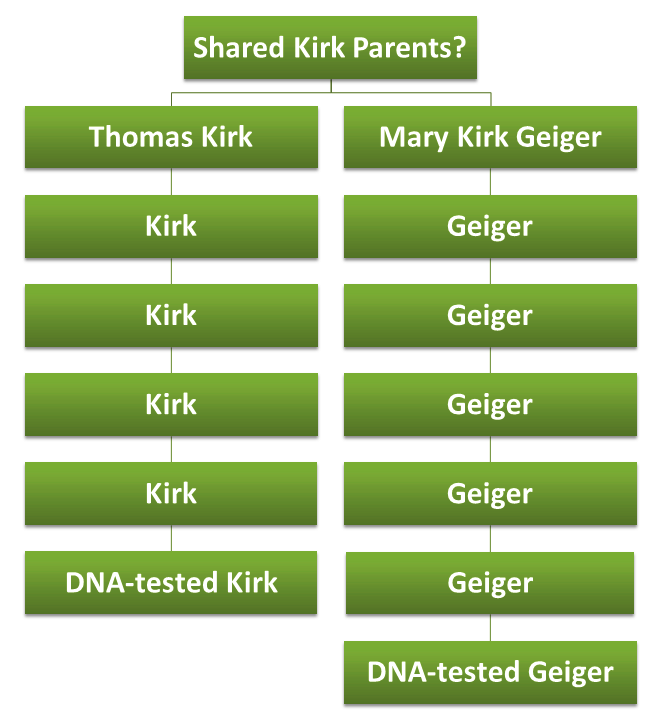 |
| (*Note that the Geiger relationship is not a direct paternal line of descent, the surname is used for illustrative purposes only.) |
According to the Shared cM Project, 5th cousins once removed share, on average, 21 centiMorgans (cM), but the amount of shared DNA can range anywhere from 0 to 79 cM. Here's how the two 5th cousins once removed stack up:
- 8.6 cMs over 1 segment
- 24.1 cMs over 2 segments
Again, the shared DNA falls within the established ranges we could expect to see for fifth cousins once removed.
Taking Stock of the Genetic Relationship
Six people who descend from Mary (Kirk) Geiger are genetic matches to a descendant of Thomas Kirk.
The amount of shared centiMorgans between them all supports the claim that they are fifth cousins (or fifth cousins once removed), which in turn indicates that Thomas and Mary were siblings. This is, of course, assuming there's no other shared ancestry between the matches, which would skew my results. To my eye, there is no other obvious overlap in the family trees.
While the evidence doesn't contradict my theory, I do recognize that the cM range for these distant family relationships are quite expansive. The shared cMs for the six cousins could just as easily be used to indicate a 6th or even 7th cousin relationship, putting another generation or two between Thomas and Mary. But what's the likelihood that six matches would show up for a single 6th or 7th cousin relationship?
All of these matches are in the largest DNA database in the family history market, which means there's currently no access to additional tools like a chromosome browser to further scrutinize the connections.
How else could I leverage these matches to determine definitively - should that be possible - that Thomas Kirk and Mary (Kirk) Geiger were brother and sister?
In the meantime, I'm increasingly confident that Thomas and Mary were siblings.


