Showing posts with label Anthony Geiger. Show all posts

Friday, July 17, 2026

A New Berkeley County, Virginia Record Strengthens the Case for Thomas Kirk's Origins

For more than a decade, I've been trying to answer a simple question:

Was my fifth great-grandfather Thomas Kirk (1778–1846) really a son of Joseph Kirk of Berkeley County, Virginia?

The evidence has steadily accumulated over the years:
  • Thomas Kirk is buried in the same small family cemetery in Licking County, Ohio as Mary (Kirk) Geiger (1774-1832) and John Beard, husband of Margaret (Kirk) Beard.
  • Descendants of Thomas and Mary are genetic matches, supporting the theory that the two were closely related (likely siblings).
  • Children of both Thomas and Mary later reported their parents were born in Virginia.
  • Family history recorded by Mary's grandson identified her as a daughter of Joseph and Sarah Kirk of Berkeley County, Virginia, with two brothers and one sister.
  • Records confirm that a Joseph Kirk lived in Berkeley County and, together with his brother John, leased a 100-acre farm from George William Fairfax in 1773.
  • After Joseph's death in about 1784, we confirmed his widow was named Sarah as she appeared in Berkeley County tax, land, and court records for nearly two decades.
  • In 1796, an unnamed adult male appeared in Sarah's household on the tax list, consistent with a son reaching adulthood (maybe our first glimpse of Thomas in Berkeley County).
  • Until now, the earliest known record naming Thomas himself was a 1799 tax list in Brooke County, Virginia, where he later married Sarah Bonar.
  • Thomas subsequently settled in Licking County, Ohio, following migration patterns seen among other members of the extended Kirk family, including his sister Mary and likely uncle John Beard.
But one problem has always remained:

Thomas himself was largely invisible in Berkeley County.

Until now.

Recently, while reviewing a digitized collection of Virginia legislative petitions on FamilySearch, I found what may be the first record to name and place Thomas Kirk himself in Berkeley County during his youth.

In a petition drafted by members of the 55th Regiment of Virginia's Militia in Berkeley County, they protested a law exempting Quakers and Mennonites (who were pacifists) from militia service while requiring others to serve in their place. They asked Virginia's General Assembly to repeal the act because it was "painful to our feelings, and evidently tends to destroy the harmony of neighbourhoods (sic), and prevent the furtherance of military discipline." The petition was adopted at militia musters held in October 1796 with Major Henry Bedinger (a neighbor of the Kirks) the lead signatory for the 55th Regiment's 1st Battalion.


Among the names appears:

"Thos. Kirk"

If this is my Thomas (and I believe it likely is) it places him in Berkeley County at age 18, exactly where I would expect him to be before his move to Brooke County in 1799. It also suggests that he was affiliated with the county's militia. Prior to this record, there was no evidence that he had ever served in armed forces.

Importantly, I have found no evidence of any other Thomas Kirk living in Berkeley County during this period. The surviving records of the 1770s, 1780s, and 1790s identify several other members of the Kirk family, including Joseph Kirk, widow Sarah Kirk, and Joseph's brother John Kirk, but no competing Thomas Kirk has emerged from the documentary record. While that does not prove the identity of the signer, it strengthens the argument that the "Thos. Kirk" appearing on this petition is the same Thomas Kirk who later settled in Ohio and is believed to have been a brother of Mary (Kirk) Geiger.


What makes the discovery even more remarkable is how it was found.

FamilySearch's AI-powered handwriting recognition has revolutionized the search for ancestors hidden in handwritten manuscript collections. Yet in this case, the technology completely missed the record. The AI transcribed the surname as "Kerk" rather than "Kirk," so searches for the Kirk surname returned nothing. The entry only came to light because I manually reviewed the images page by page.

It's a reminder that while technology is opening new doors for genealogists, it can still overlook important clues. Also, always search for name variants!

The discovery prompted me to explore other Berkeley County petitions from the same period.

Interestingly, Thomas was not the only future member of the Kirk family to appear in these legislative records, which revealed that Thomas was not the only member of the Kirk family to appear in these legislative records.

A second Berkeley County petition concerning the same controversy over militia service exemptions for Quakers and Mennonites was submitted to the Virginia General Assembly the following year. Unlike the 1796 petition, which originated with Berkeley County's militia, this petition was subscribed more broadly by county residents.

Among the signers was Anthony Geiger, the husband of Thomas's sister Mary.

Anthony and Mary would marry in Berkeley County on September 26, 1797, with John Beard, husband of Margaret (Kirk) Beard, serving as bondsman.

The petition also contains many familiar names that appear throughout Kirk research, including members of the Bedinger, Tabler, Painter, and Roush families. These are the same families who appear repeatedly in the records surrounding Joseph Kirk, widow Sarah Kirk, and the Fairfax leasehold.

Taken together, these petitions provide something larger than a few scattered names.

They offer a rare glimpse into the active citizenry of Berkeley County in the 1790s. They show Thomas Kirk, Anthony Geiger, and their neighbors participating in public affairs at precisely the time these families were establishing the connections that would eventually carry them west to Ohio.

Rather than isolated individuals appearing sporadically in tax lists and land records, we begin to see them as members of a real community.

For me, however, the headline is Thomas. The discovery of new records that name him is rare.

After years of reconstructing his early life through the records of parents, siblings, neighbors, tax lists, land records, and family traditions, I may finally have a document created during his lifetime that names and places Thomas Kirk himself in Berkeley County before his migration west.

A single abbreviated name—"Thos. Kirk"—may not seem like much.

But for researchers like me who have spent years trying to understand Thomas's origins, it is one of the most significant Kirk discoveries I've made in a long time.

Friday, April 5, 2019

A Genealogist's Love For the County Engineer's Office

In March 1838, Thomas Kirk sold his 100-acre farm in Licking Township - a small community on the southern border of Licking County.

The farm had been my fifth great-grandfather's home since 1805 when he was among the first settlers in the Ohio wilderness. In those early years, there were few people, vast stretches of untamed landscape, and no urban developments of note: no cities and no modes of transport like highways, trains, or canals.

But 33 years later all of that had changed, and Thomas moved about 23 miles northwest and settled on a 171-acre farm in Licking County's rural Monroe Township.

Why? Did he long for an escape from encroaching development?

The new National Road - America's first federally-funded road - was paved through Licking Township sometime between 1830 and 1833 and soon brought hordes of traffic and urbanization to Thomas' doorstep.

Literally, the National Road ran along the southern boundary of his Licking Township farm.

A 19th Century Freeway


Between 1825 and 1850, Touring Ohio notes that, “the National Road was the primary route immigrants and east coast settlers used in their western migration…Commerce thrived as thousands of wagons, coaches, carriages, and horseback riders moved across the state.”

The National Park Service estimates that nearly 200,000 people used the National Road every year during its heyday in the 1830's and 1840's.

In a series of vignettes recorded by Harper's Monthly in 1879, men who traveled the National Road during its prime shared recollections illustrating what ran along Thomas Kirk's doorstep:

"The wagons were so numerous that the leaders of one team had their noses in the trough at the end of the next wagon ahead and the coaches, drawn by four or six horses, dashed along at a speed of which a modern limited express might not feel ashamed. Besides the coaches and wagons, there were gentlemen travelling singly in the saddle, with all their luggage stuffed into their saddlebags. There were enormous droves of sheep and herds of cattle, which raised the dust like a cloud along their path."

It was the 19th century equivalent of Los Angeles' 405 barreling under Thomas' nose with the Eastern Seaboard moving past his home on its way west to manifest destiny.

Whether the National Road proved too much for Thomas remains uncertain. But what is now known, thanks to Engineer's Office of Licking County, is that he had been a supporter of early development efforts.

County Engineers Are A Genealogists Best Friend


To all the genealogists out there, listen carefully!

If you haven't already reached out to the Engineer's Office in the counties of your ancestors, I strongly recommend that you do so. Now!

At the recommendation of the Licking County Recorder, I contacted the Engineer's Office to ask about the existence of early county maps.

A single-sentence reply came back from the county's engineer himself with a hyperlink to scans of the office's historic records.

The no-frills webpage that loaded was a directory grouped by categories like Atlas and MapsOriginal Plats and Field NotesRecord PlatsRight-of-Way, and Surveys

I found detailed maps of Licking County and its townships that illustrate the changes of property ownership from Thomas Kirk's days up to the early 20th century. I've long toiled with following the transformation of the property boundaries over the years. That job was just made so much easier!

But The Real [Unanticipated] Gold


The maps were an exciting find. If that was all the County Engineer shared with me, I would have been happy and called it a successful day.

But wait! There's more! [insert studio audience gasp here]

I peeked inside the Right-of-Way directory and found a sub-directory for Road Records. Within another sub-directory there more than 300 TIF files.

I clicked into the first record and loaded up an image of a handwritten June 1808 petition to the Licking County Board to build a road.

Licking County was formed in 1808. I was looking at records that shaped the development of Thomas Kirk's hometown and driven at the request of local community members.


Now, let's pause here for just a moment.

My genealogical research into Thomas Kirk has long ago exceeded the bounds of a traditional reasonably exhaustive search. I have a borderline obsessive bloodthirst desire to find every record that mentions Thomas. I have to. There are very few records touching on his life that survived Licking County's 1875 courthouse fire. Advancing my Kirk genealogy could hinge on a yet-to-be-discovered piece of evidence tucked away in the most obscure corner. I've made it my business to find every.single.record that mentions Thomas Kirk. And I have now spent years surfacing every.single.record that mentions Thomas Kirk. Until this week, I didn't think there were any more records in Licking County with Thomas' name on them that I hadn't already seen.

Until this week. [Now back to our story]


I began reviewing - page by page - the unindexed volume of petitions for roads to be built across the fledgling Licking County.

I kept "turning" the pages [opening new digital files] and quickly scanning the text for familiar names. Many records read something like this:

"Be it remembered that on the 4th day of December 1815, Ezekiel Wells and others presented a petition for a road as follows..."

Who were the and others? Maybe my kinfolk? Maybe Thomas Kirk? Almost none of the records detailed the parties entreating the county government to build their proposed roads. Almost none.

But the genealogy stars must have aligned because as I continued opening files, I came to page eleven.

"Be it remembered that on the 25th day of September AD 1810 John Stadden and others presented a petition for the establishment of a road from Newark toward Lancaster, which said petition reads as follows."

"To the Commissioners of Licking County O.

We the undersigned citizens of Licking County, being sensible of the difficulty we are likely to labor under in consequence of the road leading from Newark to Lancaster as the sum has never been confirmed or established, and if there is money to be appropriated to the use of said road, we pray that a view and survey or such other proceedings as the Board may think for the welfare of the public as speedily as the nature of the ease will admit."

Nearly all of the handwritten petitions concluded there, but this record - this beautiful record - began listing the names of the and others.

There was John Stadden, Andrew Beard, William Hains, H. Pugh, P. Cunningham, Martin Lincoln, Adam Kits, and then... genealogy gold...

... Thos Kirk ...

My fifth great-grandfather, the man who may have moved further afield in the county to escape the hubbub that accompanied the heavily-trafficked National Road, was among the petitioners in 1810 who asked the county to build a road running south from Newark to the Licking County line towards Lancaster.

Among the petitioners were two other names of note:

John Beard was married to Margaret Kirk who I speculate was an aunt to Thomas Kirk. In 1812, John and Margaret sold Thomas the 100-acre farm in Licking Township that he had leased from them since 1805.

Anthony Geiger was married to Mary Kirk who I speculate was a sister to Thomas Kirk. John Beard had served as Mary's surety on her wedding bond.

Thomas Kirk along with likely uncle-in-law John Beard, and brother-in-law
Anthony Geiger petitioned county officials for construction of a road.

A path for the road was platted and eventually approved by the County Commissioners: "Whereupon it was ordered that said road be established a public highway."

Page twelve of the digitized records included a sketch of the road. 

Comparing it to the area on modern Google Maps, I realized that this road still exists today and is known as the Jacksontown Road or Highway 13.

The Jacksontown Road bordered Thomas Kirk's 100-acre farm along its western edge.

Sketch of the proposed road between Newark and the Fairfield County line
Thomas Kirk's 100-acre farm is detailed in red.

Jacksontown Road/Highway 13 on Google Maps. Thomas Kirk's 100-acre
farm sat at the northeast intersection of the road with the National Road (Highway 40).

A Lesson For the Family Historian


The key lesson for the family historian is to be sure that you have been in touch with all county offices that may have historic records. You may be so fortunate as to discover a county engineer who has digitized the records and is willing to share them with you.

Of course, this petition didn't tell me that Thomas Kirk was the son of [insert long-sought-after name here], but it did help me understand that he was an active voice in his community who sought development of his home county. That's invaluable to me because I have so little information detailing Thomas' perspectives and activities.

Have you had success finding family history records with a county engineer's office? What other unconventional county offices have helped your genealogical research?

Saturday, March 31, 2018

Were They Brother and Sister? Verifying an 18th Century Relationship with Autosomal DNA

Were Thomas Kirk, my fifth great-grandfather, and Mary (Kirk) Geiger siblings?

I believe DNA has finally given me an answer.


A Web of Parallels


Setting DNA aside for just a moment, there were a few curious facts that initially made the siblingship case worth considering, including:

Name:  Given my extensive research into Thomas Kirk, any Kirk who crossed his path or simply toe-tapped into his proximity was an immediate person of interest and required a full-fledged investigation. Naturally, when Mary Kirk, who married Anthony Geiger in 1797 in Martinsburg, Virginia (now West Virginia), appeared in the same Ohio neighborhood, the sleuthing commenced with an excited fury.

Age:  They shared a close proximity in age. Born in 1778 in Virginia, Thomas was just four years younger than Mary who was born in 1774. 

Time and Space:  They both lived in the same geography and timeline. Tax records confirmed that Thomas, my fifth great-grandfather, was in Licking County, Ohio by 1805. Meanwhile, a 1901 biography of Mary's grandson Richard Geiger, recalled that "In 1804 he [Mary's husband Anthony Geiger] came to Ohio, the year following the admission of the state into the Union, and located in Licking County..." Mary was even buried in the same cemetery as Thomas. Only a few yards separate them in their eternal rest.

Although these facts coalesced around my theory, there was still no explicit evidence of a family relationship.

Finding Family With Saliva


What, if anything, could DNA tell me about their possible connection?

The first challenge with autosomal DNA is that the genetic material inherited from a given ancestor fades with each subsequent generation. As a result, the strength of autosomal DNA matching only goes back about five, six or maybe seven generations.

To put this another way, consider approximately how much DNA we inherit from each preceding generation: 50% of our DNA came from our fathers and the other half from our mothers. Jump back another generation, and we've inherited 25% of each of our grandparents' DNA. As you climb back each generation, the average amount of inherited DNA decreases by half. The further back you go, the numbers slim proportionally until the DNA is virtually indiscernible.

Exactly how much of Thomas Kirk's DNA should I have? As a fifth great-grandson, I could expect to share less than 1% of his DNA (0.78% to be exact). If we were to graph my DNA, Thomas would represent a slim sliver.


Of course, DNA is rarely that straightforward. The process is further complicated because we don't necessarily inherit DNA from all of our ancestors at this distance. For a more detailed explanation on this quandary, I defer to genetic genealogist Roberta Estes who has addressed this issue in her blog Ancestral DNA Percentages - How Much of Them is in You.

Mindful of the pittance of autosomal DNA that I've inherited from Thomas, I'm fortunate to have a first cousin twice removed - two generations closer to Thomas than me - who tested her autosomal DNA. As a third great-granddaughter of Thomas, she's inherited approximately 3.12% of his DNA.

More DNA, of course, means increased odds for matching genetic Kirk cousins. Could we link her to any of Mary (Kirk) Geiger's descendants?

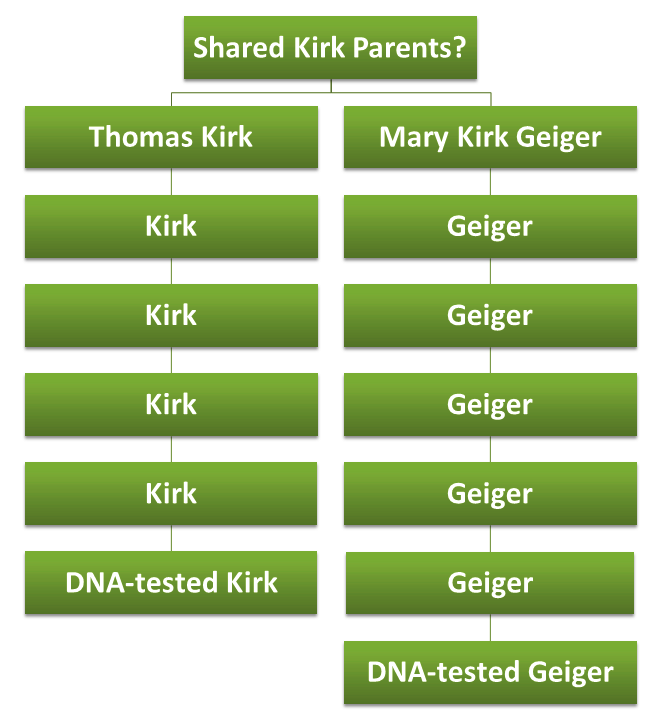
I searched my Kirk cousin's DNA matches for the surname Geiger and found six individuals who had a pedigree that traced back to Anthony and Mary (Kirk) Geiger. At first blush, it seemed there was indeed a genetic relationship between descendants of Thomas Kirk and Mary (Kirk) Geiger.

Crunching the CentiMorgans to Verify Relationships


My next step was to evaluate the accuracy of these six genetic matches, and determine whether the amount of shared DNA corroborated a sibling relationship between Thomas and Mary.

I do this by making the assumption that Thomas and Mary were siblings and calculating the descending relationships between my Kirk cousin and her Geiger matches accordingly.

Next, I examine how much DNA each match shares and whether this falls within the verified range for similar family relationships.

To make this assessment, I rely on The Shared cM Project, an invaluable tool developed by genetic genealogist Blaine Bettinger.

Bettinger has polled an enormous number of DNA testers and their known relationships to determine the average amount of centiMorgans (a DNA measurement) an individual could expect to share with cousins at various levels. The expansive chart details both the average amount of centiMorgans (cM) common for a particular relationship as well as the range of cM that exists for that particular relationship.

If Thomas Kirk and Mary (Kirk) Geiger were in fact siblings, the published pedigrees indicate that four of the six individuals would be fifth cousins with my Kirk cousin. Their relationship would look like this:

(*Note that the Geiger relationship is not a direct paternal line of descent,
the surname is used for illustrative purposes only.)

According to the Shared cM Project, fifth cousins share, on average, 25 centiMorgans (cM), but the amount of shared DNA can range anywhere from 0 to 94 cM. So, where do each of those four 5th cousins fall?

  • 18.2 cMs over 2 segments
  • 33 cMs over 2 segments
  • 35 cMs over 2 segments
  • 12.8 cMs over 1 segment
While there is some variation among the four and none individually match the average, all fall well within the range that you would expect to see for a fifth cousin relationship. The average cMs for these four is 24.75 - a near exact match to the fifth cousin average.

Two of the six Geiger matches would be fifth cousins once removed. Assuming Thomas and Mary are siblings, their relationship to my Kirk cousin would look like this:

(*Note that the Geiger relationship is not a direct paternal line of descent,
the surname is used for illustrative purposes only.)


According to the Shared cM Project, 5th cousins once removed share, on average, 21 centiMorgans (cM), but the amount of shared DNA can range anywhere from 0 to 79 cM. Here's how the two 5th cousins once removed stack up:

  • 8.6 cMs over 1 segment
  • 24.1 cMs over 2 segments
Again, the shared DNA falls within the established ranges we could expect to see for fifth cousins once removed.

Taking Stock of the Genetic Relationship


Six people who descend from Mary (Kirk) Geiger are genetic matches to a descendant of Thomas Kirk. 

The amount of shared centiMorgans between them all supports the claim that they are fifth cousins (or fifth cousins once removed), which in turn indicates that Thomas and Mary were siblings. This is, of course, assuming there's no other shared ancestry between the matches, which would skew my results. To my eye, there is no other obvious overlap in the family trees.

While the evidence doesn't contradict my theory, I do recognize that the cM range for these distant family relationships are quite expansive. The shared cMs for the six cousins could just as easily be used to indicate a 6th or even 7th cousin relationship, putting another generation or two between Thomas and Mary. But what's the likelihood that six matches would show up for a single 6th or 7th cousin relationship?

All of these matches are in the largest DNA database in the family history market, which means there's currently no access to additional tools like a chromosome browser to further scrutinize the connections. 

How else could I leverage these matches to determine definitively - should that be possible - that Thomas Kirk and Mary (Kirk) Geiger were brother and sister? 

In the meantime, I'm increasingly confident that Thomas and Mary were siblings.

Sunday, June 4, 2017

The Ties That Bind: A Sister Undercover

My fellow blogger Janice Harshbarger (and maybe cousin) turned me on to a possible clue that may help me solve one of my most pressing genealogy mysteries: who were the parents of my fifth great-grandfather Thomas Kirk and what were their ancestral origins?

Thomas Kirk was born in 1778 in, most likely, Virginia, and settled in Licking County, Ohio where he died in December 1846. There's little documentation that sheds light on his pre-Ohio existence or the identities of his parents.

Janice commented last fall that she had a Mary Geiger in her tree whose maiden name was Kirk. Mary lived with her husband Anthony in Licking County at the same time as my Thomas (check out Janice's blog on Anthony and Mary Geiger).

Could Mary be Thomas' sister, Janice wondered?

DNA Clues Me In
About this same time, a DNA match appeared on Ancestry for an older Kirk cousin whose kit I administer. This match - estimated to be a 4th to 6th cousin - had a tree that included (drum roll, please) Mary Kirk Geiger.


Fourth to sixth cousins would share third to fifth great-grandparents. In this particular scenario, if Thomas and Mary were siblings, their parents would be fifth great-grandparents to both DNA testers.

Could there really be something to this theory that Mary was a relative to Thomas? The genetic match seemed to reinforce Janice's conjecture.

Bond. Marriage Bond
The most curious bit of evidence, though, is a marriage record for Anthony Geiger and Mary Kirk. Their marriage bond, dated September 27, 1797 in Martinsburg, Berkeley County, Virginia (now West Virginia), indicated that "a marriage is suddenly intended to be solemnized between" them.

The bond was between Anthony Geiger and John Beard who was the surety (bondsman). Typically, these bonds were made between the groom and a family member of the bride - not always the father - sometimes a brother or uncle.

Anthony Geiger and Mary Kirk marriage bond with John Beard as surety.

The name John Beard means something to my Thomas Kirk research. 

A John Beard lived in Licking County in the early 19th century, was married to a Margaret Kirk (relationship, if any, unknown), and sold my Thomas 100 acres of land in Licking County on January 25, 1812.

Land deed between John and Margaret (Kirk) Beard and Thomas Kirk.

In the written record, John Beard links Mary (Kirk) Geiger and my Thomas Kirk.

Is it too much to infer a familial link existed? If one did, what type of relationship? Were they siblings? The DNA match is for a relatively distant relationship, and autosomal DNA becomes less reliable for each preceding generation.

But the clues keep stepping over themselves suggesting the two individuals were somehow connected.

Was Mary a sister to Thomas and, as a result of the ravages of time, that relationship is now undercover?

The search is heating up. This new cast of characters - Mary (Kirk) Geiger and John Beard - hold great potential for helping me surmount one of my most impenetrable brick walls.