Showing posts with label Licking County. Show all posts

Saturday, December 9, 2023

I Found Sarah Kirk’s Missing Footstone

I found my fifth great-grandmother Sarah (Bonar) Kirk’s missing footstone!

While researching Sarah and her husband Thomas Kirk’s genealogy in the 1990s, Donald and Theresa Kirk (4th cousins twice removed) traveled to Licking County, Ohio and photographed their graves in the Beard-Green Cemetery. At that time, both Thomas and Sarah’s headstones were already cracked in half. Thomas’ headstone had metal brackets clamping the two pieces together. Unfortunately, the upper portion of Sarah’s headstone - with her biographical information - was missing. 

Thomas and Sarah (Bonar) Kirk's graves with their original stones broken in half.
Author pictured in 2023.

Thomas Kirk's original headstone intact. 
Photographed by Donald and Theresa Kirk in the 1990s.

The upper piece of Sarah's headstone must have been missing for a long time because she wasn’t recorded in the two censuses of cemetery burials conducted in 1940 and again in 1970. Sarah, who died in 1835, was now buried in a nearly unmarked grave following decades of exposure to the elements.

Sarah’s grave would have been anonymous except for one clue. Donald and Theresa also photographed her original footstone. Her initials “S.K.” were carved in the stone and provided the only evidence that it was Sarah who was buried beside Thomas.  

Sarah (Bonar) Kirk's footstone pictured in the 1990s by Donald and Theresa Kirk.

When I made my first trip to the Beard-Green Cemetery in July 2017, I discovered that the upper portion of Thomas’ headstone and Sarah's footstone were now both missing. I searched for them without success.

During a subsequent visit to the cemetery in July 2020, I found the tip of a buried stone alongside the headstone for their son Vachel. Firmly embedded in the ground, I was unable to excavate it. I assumed I had discovered Sarah’s missing footstone. 

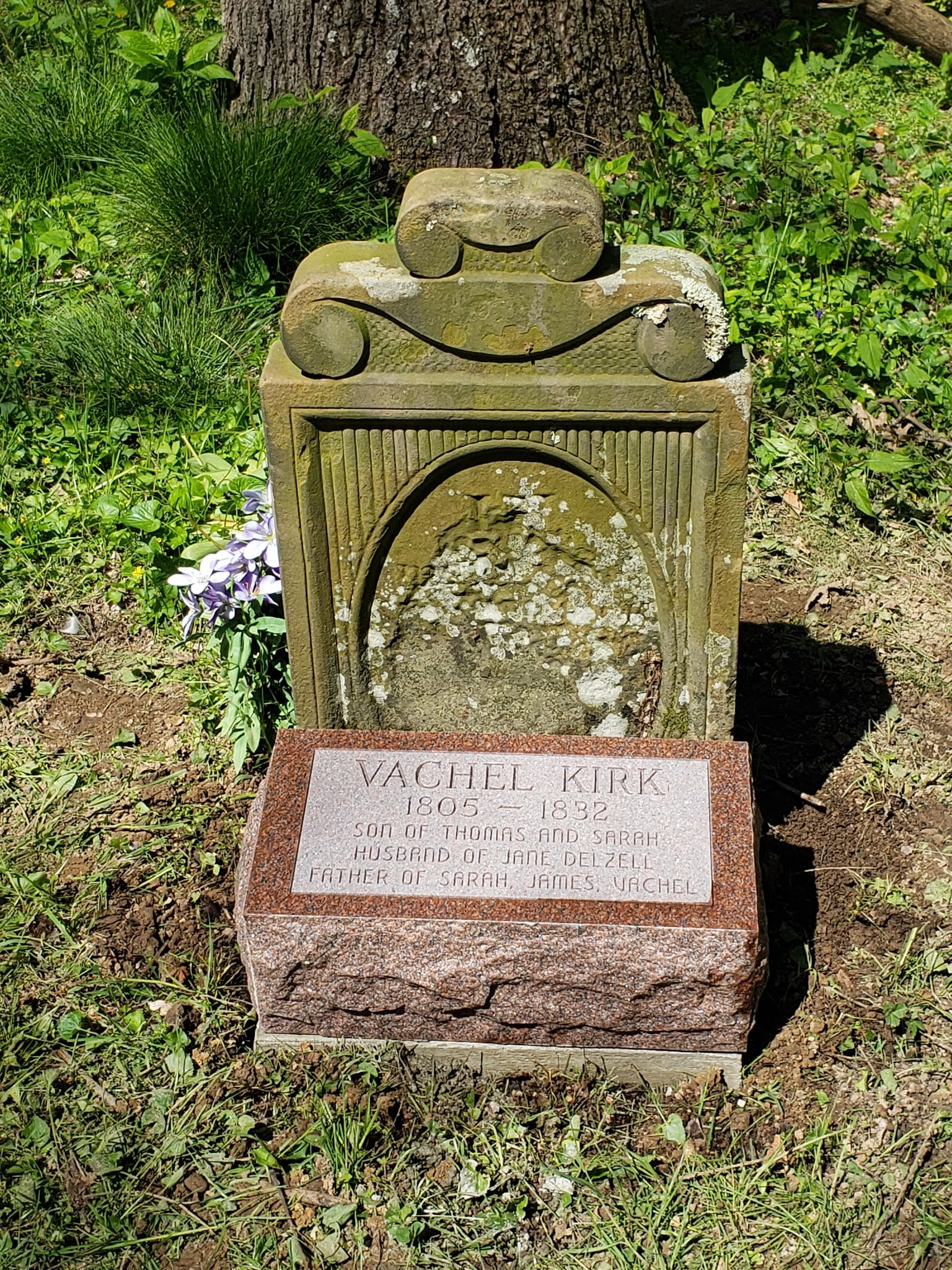
Vachel Kirk's original headstone with a stone buried alongside.

In spring 2021, I worked with a local monument company to place a new headstone for Vachel and asked that they dig up what I figured was Sarah’s long lost footstone. They were able to pull it out. Unfortunately, the stone was broken and no longer included the portion with initials. I thought we’d lost more of Sarah’s history.

The unearthed footstone (from alongside Vachel's headstone) was broken and didn't include the portion with initials. At first, I assumed it was Sarah (Bonar) Kirk's footstone.

That assumption was undone this past June. I made a speedy road trip to Licking County and stopped at Beard-Green to clean up the Kirk graves and place new flowers. While tidying around Vachel’s grave, I noticed the telltale signs of a stone buried behind his original headstone. 

In June 2023, I noticed a new stone emerging from behind Vachel's headstone.

I’ve been over that patch of ground countless times during my four previous visits and I've never seen any signs of a buried marker. Perhaps the landscaping crew had recently uncovered some topsoil that revealed a portion of the stone. I was able to unearth the rest of it and immediately spotted the initials “S.K.” 

I was stunned! I quickly realized that I had found Sarah’s footstone that was last seen in the 1990s. The 188-year-old stone was buried in the exact area where Donald and Theresa had photographed it 30 years ago.

I uncovered the stone that turned out to be Sarah (Bonar) Kirk's original footstone with her initials "S.K."

If that was Sarah’s footstone, it immediately raised the question of whose footstone I found in July 2020. Because of its location near the Kirk graves and that it’s made from the same type of stone and is approximately the same width as Sarah’s, I presume it’s Thomas’ original footstone. 

Sarah's newly discovered footstone (left) leaves me speculating that the other footstone belongs to Thomas Kirk.

I plan to work with a monument company to discuss preservation options and whether the markers can be safely reset. If you have experience with footstone restorations or recommendations, please share in the comments.

Friday, May 14, 2021

Renewed Remembrance in Stone

When I first visited the grave of my fourth great-grandfather Vachel Kirk (1805-1832), I was disappointed to discover that his original headstone was illegible. The marker, slanted skyward, was fully exposed to the elements. No doubt decades of snow and rain pounding at the surface completely eroded the inscription away. 

Vachel Kirk's original headstone, the inscription worn away

The only way to pinpoint the grave as Vachel's was the small footstone engraved with his initials "V.K." This marker was also beginning to succumb to damage. Pieces of the stone were flaking off around the delicate lettering.

Vachel Kirk's original footstone with the initials VK

My visit seemed fortuitous. I was able to confirm the burial location before the identifying memorials were completely destroyed. 

After having crowd-sourced a new headstone for Vachel's parents Thomas and Sarah (Bonar) Kirk (who are buried just feet away in the same cemetery on the other side of a walnut tree), I felt compelled to also preserve his memory for generations to come.

Last summer, I ordered a new headstone for Vachel. Cut from the same red Wausau granite as his parents', it was finally placed earlier this month. I took the liberty of adding some genealogical context, including his parentage, spouse and children.

Vachel Kirk's new headstone, placed in May 2021

"As long as there is one person on Earth who remembers you - it isn't over." -Oscar Hammerstein, Carousel

Have you placed a new headstone for an ancestor whose grave was unmarked or whose marker had seen better days?

Sunday, March 14, 2021

The Last Record of Thomas Kirk

When Licking County's courthouse went up in smoke in 1875, a lot of Thomas Kirk's recorded history was lost, including his probate file - a rare window into his socioeconomic status and family relationships.

Thomas - my fifth great-grandfather - died aged 68 on December 3, 1846 without a will, so the settlement of his estate likely generated a lot of paperwork (no doubt a pain for his heirs, but a goldmine for family historians if only the documents had survived the flames). The probate process would have inventoried and appraised all of his property (including possessions of the home and farm), tallied sales at auction to recoup funds to pay debts (if he had any), and stipulated who inherited what.

Although probates were lost, the minute books that detailed every action taken by Licking County's Court of Common Pleas miraculously survived the fire. When the court convened on March 13, 1847, it acknowledged Thomas' death intestate and appointed his son James as administrator of the estate.

Surviving land records showed that the settlement process continued into 1848 when Thomas' heirs at law (his eleven children with his first wife Sarah Bonar) began selling their shares of his 171.96-acre Monroe Township farm (located in the county's northwest). The last deed of sale was signed on April 14, 1849, when heirs Loyd and Jane (Kirk) Tracy and Hugh and Jane (Hartsock) Kirk jointly sold their stake in the property. They were delayed in finalizing their sale because they had moved to Crawford County, Illinois - over 300 miles west of Licking County, Ohio.

But when was Thomas' estate finally settled?

While it's fortunate that the court's minute books escaped the fire and have now been digitized, they're not indexed which required a tedious page by page review. The court clerk's chicken scratch spans many volumes and thousands of pages. I spent several months trawling through the books trying to decipher penmanship - hoping to find mention of Thomas. In the process, I learned a lot about the crimes and legal grievances of Licking County's early citizenry. I also learned that Thomas was a good citizen - never appearing in court accused of transgressions - who served as a juror and was even called as a witness in a murder trial.

Just when I thought my eyeballs couldn't take it anymore, I finally struck gold (call it the luck of the Irish)!

On October 23, 1850 - nearly four years after Thomas was "accidentally killed" - I found an entry for James Kirk, administrator of the estate of Thomas Kirk, deceased, "having filed accounts current with vouchers and the same having been published and noticed by the Clerk of this court in the Licking Herald, a newspaper according to law, and said accounts and vouchers having been examined by a Commissioner of this Court and found in all things legal and correct and reports being respectively filed by such Commissioners and examined and approved by the Court, the said accounts are hereby finally settled and ordered to be recorded to wit."

Licking County, Ohio Court of Common Pleas - 23 October 1850

With that notation, the court clerk recorded what was likely Thomas Kirk's last appearance in Licking County's records and wrote the final chapter on one of the jurisdiction's earliest settlers.

Citation:
Licking County Court of Common Pleas. Journals 1849-1852. Film 485309. DGS 8558259. Common Pleas Journal Book 1850. Journal page 234, Digital page 414. 23 October 1850. Digitized by FamilySearch. https://www.familysearch.org/.../3:1:3Q9M-C3Q2-LSGS-C...

Thursday, August 6, 2020

Little Old Cemetery On Our Place

Nestled in the densely forested grounds of the Dawes Arboretum is one of the oldest cemeteries in Licking County, Ohio.

The Beard-Green Cemetery is the final resting place for several of my paternal ancestors.

A historical marker details the backgrounds of the 210-year-old cemetery's namesakes, including Benjamin Green and his family who were the first legal settlers in spring 1800 of the area that would become Licking County in 1808. The marker also indicates that John Beard's family settled in 1808. 

Beard-Green Cemetery historical marker, photo by author

John Beard, who was married to Margaret Kirk, actually settled in the area at least two years prior to 1808. John was enumerated on the 1806 tax list for Fairfield County (the predecessor to Licking County), and purchased 400 acres in Licking Township, Fairfield County in January 1807. That deed indicated that John was "of Fairfield County..." and not just an out-of-towner buying up land.

But quibbles about the accuracy of the historical marker aside, the cemetery is an important place for my family history. 

John and Margaret Beard were, I believe, uncle and aunt to my fifth great-grandfather Thomas Kirk and his likely sister Mary (Kirk) Geiger - both of whom are also buried in the cemetery grounds. I believe John Beard was a father figure - if not legal guardian - for Thomas and Mary following the death of their father Joseph Kirk in Berkeley County, Virginia in about 1784. 

Missing and Deteriorating Headstones


Sadly, the passage of time has not been kind to many of the cemetery's headstones. While John Beard's marker stands prominent and majestically more than 200 years after his 1814 death, others are crumbling with weathered inscriptions or altogether missing.

Gone is the headstone for John's wife, Margaret. Presumably she was laid to rest beside her husband, but which side? There's a crumbled stone embedded in the ground to the right of John's marker (behind the flag in the picture below). However, there's no legible engraving. I've long assumed that was all that remained of Margaret's marker.

John Beard 1814 headstone, photo by author

Among the deteriorating memorials are fragments of the tombstones for my fifth great-grandparents Thomas and Sarah (Bonar) Kirk. Regrettably, the upper portion of their stones - with the invaluable biographical data - is now missing. A caretaker of the cemetery told me that many of the broken stones were buried in the northwest corner of the cemetery. 

In 2017, I worked with other Kirk descendants to lay a new headstone, which was placed between the stumps of their original headstones and commemorated their role as early settlers of Licking County.

Thomas and Sarah Kirk graves, photo by author

An exact date of death


I've long wondered what was engraved on Thomas' original tombstone. Did it provide his exact death date?

A family history published in the 1990's gave his death date as December 3, 1846, but there was no citation for where that date came from. Did it come from the tombstone?

The author of that history had visited Beard-Green and included a grainy photograph of Thomas' original headstone when it was still intact (albeit barely hanging on, clamped together by metal braces). Perhaps the stone was legible and the exact death date was pulled from the marker.


In June 1970, a local genealogy society conducted a census of burials - recording the basic bio-data that was still readable. Thomas' headstone was standing, but the information recorded was pretty basic.


Great, I had the birth and death years. I didn't want to be too greedy, but it sure would be nice to know what exactly was on the stone. Many of the markers in the cemetery give the deceased's name, exact death date and the age at death, which can then be used to calculate the birth year. 

Was that the case for Thomas?

Notes on a cemetery


During a recent visit to the genealogical society in Newark, Ohio, I landed on a new document that provided more insights. 

It was a photocopy of a notebook kept by Bertie Dawes (1872-1958), co-owner and caretaker for the surrounding Dawes grounds on which the cemetery is situated, titled, "Little Old Cemetery on our place."

The journal includes a map of burial locations (Margaret Beard was buried to the left of her husband!) and an index detailing the known burials in 1940. It also provides more of the information inscribed on each stone, including for Thomas.

In a handwritten list of burials ordered chronologically by year, Dawes recorded Thomas Kirk under 1846.


There it was in black and white. Thomas Kirk's tombstone gave his death date as December 3, 1846 at the age of 68 years, which suggested a birth year of 1778. 

This was the first time I had confirmation that the stone was the source of this information.

Although the data wasn't entirely new, Dawes' notebook provided a reference point, a citation that I could point to as corroborating evidence of Thomas' birth and death dates. That's important in any genealogy and strengthens my Kirk family history. 

Saturday, April 18, 2020

A Sister Emerges From the Shadows

Although he's not my direct ancestor, George W. Geiger is an important source of information that is helping me pole-vault over my patrilineal brick wall.


Born in 1841, George Geiger was the grandson of Mary (Kirk) Geiger (1774-1832). Mounting evidence has led me to speculate that Mary was the sister of my fifth great-grandfather Thomas Kirk (1778-1846).

George is indispensable to my research because he compiled details about his immediate family's history. Those records endured over time when many others were lost to fire or poor record keeping.

Among his research were exacting details about his grandmother:

Mary (Kirk) Geiger was born in Virginia in 1774. She was of Irish descent and daughter of Joseph and Sarah Kirk. She had two brothers and one sister.

Pinpointing Joseph and Sarah Kirk as Mary's parents has allowed me to infer that they were also Thomas' parents.

If Thomas and Mary were siblings born to Joseph and Sarah Kirk of Virginia, who was the unnamed sister?

Finding family


Although George Geiger's surviving notes do not name Mary's three siblings, there is a candidate up for consideration to be the sister.

When Thomas Kirk died in December 1846, the Licking County, Ohio probate court appointed three men to appraise his estate. One of them was Hugh Ford.

Court-ordered appraisal of Thomas Kirk's estate, names Hugh Ford
March 13, 1847

At the time of Thomas' death, Hugh was his neighbor and lived on a farm to the north in Monroe Township, Licking County.

Detail of 1847 Monroe Township, Licking County, Ohio map
highlighting land owned by Thomas Kirk and Hugh Ford

Fifteen years earlier, on November 29, 1831, Hugh and his wife Ann bought their Monroe Township farm in two separate land transactions. According to their son Hugh Ford Jr., the Ford family moved to the farm in 1832 from Belmont County, Ohio, where they had lived since about 1803.

Curiously, the two deeds were witnessed by, drum roll, please...

Thomas Kirk!

Monroe Township, Licking County, Ohio land deed, purchased by Hugh Ford
witnessed by Thomas Kirk

In 1831, at the time of these transactions, Thomas Kirk lived in Licking Township. He didn't move to Monroe Township, south of the Fords, until seven years later in 1838.

Why would Thomas Kirk be a witness on two land deeds for Hugh Ford who lived ninety miles to the east in Belmont County?

Was there a relationship between the two men?

Identifying the unnamed sister


I began digging into the identity of Hugh's wife Ann.

Again, according to son Hugh Ford Jr., Ann Ford "was born December 26th, 1777, and was married to Hugh Ford September 18th, 1800." Ann lived to be enumerated in the 1850 US Federal Census, which gave her birth location as the state of Virginia (just like Thomas and Mary!).


Junior also wrote that his mother was the daughter of a man named Joseph Kirk.

Kirk!

Ann's maiden name was Kirk!

Ann's father, like Mary (Kirk) Geiger's and likely Thomas', was named Joseph Kirk!

What were the odds that Thomas would be a witness on two land deeds for a man who lived ninety miles away and was married to a woman born in Virginia who was the daughter of a Joseph Kirk?

Prior to his appearance in Belmont County, tax records placed Hugh Ford across the Ohio River in Brooke County, Virginia. Hugh appeared on Brooke County tax records from 1797 to 1802.

It's worth noting that Thomas Kirk was also in Brooke County from 1799 to 1803. It was here that he met and likely married his wife Sarah Bonar.

A brief notation from a Brooke County minister confirmed that Hugh Ford and Nancy Kirk were married on December 18, 1800 [note that this date is three months later - to the exact day - than the marriage date given by their son Hugh Jr]. Also, Nancy was, according to FamilySearch, a common diminutive nickname for Ann.

1800 Brooke County, Virginia marriage of Hugh Ford and Ann "Nancy" Kirk

Presumably Hugh and Ann (Kirk) Ford moved from Brooke County, Virginia to Belmont County, Ohio in about 1803.

According to Bonar family history, Thomas and Sarah (Bonar) Kirk moved to Captina in Belmont County after they left Brooke County. Did Thomas and Sarah follow his sister and brother-in-law into the burgeoning Ohio frontier?

It's also worth flagging the naming patterns employed by all three Kirks:


  • It appears that Hugh and Ann Ford named their first four children after their parents. Two of the four were Henry and Rachel - the names of Hugh's parents. The other two were Joseph and Sarah. We know Ann's father was Joseph, so can we infer that her mother was named Sarah? If yes, that would suggest Ann was also the child of a Joseph and Sarah Kirk just like Mary (Kirk) Geiger and Thomas Kirk. Furthermore, Ann's last child, a son, was named Thomas Kirk Ford (middle name Kirk!). Was this an homage to her brother?
  • Mary (Kirk) Geiger's first two children were named Joseph and Sarah.
  • Thomas Kirk also had children named Joseph and Sarah.

The paper trail seems to suggest a family relationship. What do you think? How off the wall are my interpretations?

Next up is to try and find DNA matches - if possible at this distant relationship level - to help prove that Thomas Kirk and Mary Geiger were siblings with Ann Ford. The research journey continues.

Saturday, October 5, 2019

The History of an Ohio Farm: From President John Adams to Grandpa Thomas Kirk

In the summer of 2017, I stood on the Licking County, Ohio land that my fifth great-grandfather Thomas Kirk once owned in the early part of the 19th century.

In the 200 years since he purchased the property, the landscape had changed considerably. His 100 acres of farmland were now developed with homes and manicured lawns and trees that obfuscated the original contours of the property. Despite the evolution, I could sense the history of the land.

Gazing towards Thomas Kirk's 100-acre farmland
Licking Township, Licking County, Ohio

It was this land that Thomas sold on March 1, 1838, to Charles Wallace for $2,000. This sale price represented a whopping return on Thomas' initial $175 investment. Over a span of 26 years, the value of the 100 acres grew more than 1,000%.

Perhaps the close proximity to the recently-built National Road made the land a lucrative investment. Profits aside, it may have been the sheer beauty of the land that prompted Wallace to make the purchase. A private family history on the shelves of the Licking County Genealogical Library includes a handwritten note:

"Charles Wallace worked on the 'National Pike' from 1828 on to 1835 part time from before Wheeling to Springfield [Illinois]. He rode horse back with saddle bags and superintended the masonry all along and when pay day came he paid off the men working on the stone culverts, some of which are still standing and being used. Going back and forth so many trips between Wheeling and Columbus he thought this farm was the prettiest between these two places... He thought about these things for a long time... finally he bought this farm."
March 1, 1838 deed of sale: Thomas Kirk sold 100 acres in
Licking Township, Licking County, Ohio to Charles Wallace.

Over a quarter century earlier, Thomas had bought the 100-acre farm from John and Margaret (Kirk) Beard. On January 25, 1812, in his first documented land transaction, Thomas paid the Beards $175 "current money of the United States" for 100 acres - a tract of land "situated in the Fourth Section, First Township and Twelfth United States Military Range."

January 25, 1812 deed of sale: Thomas Kirk bought 100 acres in
Licking Township, Licking County, Ohio from John Beard

Where did John Beard get the land from? On March 23, 1807, "John Beard of Fairfield County" (the county from which Licking was formed in 1808) paid Samuel Dick $700 for 400 acres located in "that certain tract or parcel of land...of the fourth quarter of the first township of the twelfth range of the tract appropriated for satisfying warrants for military services held by deed from Martin Baum and William C Schinek of the date of the 20th September in the year one thousand eight hundred..."

March 23, 1807 deed of sale: John Beard bought 400 acres in
Fairfield County, Ohio from Samuel Dick

Nearly seven years earlier on September 20, 1800, Martin Baum and William C. Schenek "...both of the United States territory north west of the river Ohio..." sold to Samuel Dick "...for and in consideration of the sum of five shillings to them in hand well and truly paid..." 2,800 acres belonging to "...a certain tract or parcel of land being a part of the fourth quarter of the first township in the twelfth range of the tract appropriated for satisfying warrants for military services..."

September 20, 1800 deed of sale: Samuel Dick bought 2800 acres in the fourth
quarter, first township, twelfth range from Martin Baum & William Schenek

Licking County's Engineer shared a modern map where he highlighted the border of the fourth quarter, helping to identify the land.


Only months earlier on March 29, 1800, Martin Baum and William C. Schenek were granted 4,000 acres "being the fourth quarter of the first township in the twelfth range of the tract appropriated for satisfying warrants for military services" by President John Adams.

March 29, 1800 military service land grant from President John Adams
to Martin Baum and William C. Schenek

Over 38 years and several owners, the land once farmed by my fifth great-grandfather traced its ownership origins to President Adams who doled it out to two men in recognition of military service to the United States, and who, in turn, sold it for mere shillings.

Have you traced your ancestral land back or forward in time? What did you discover?

Saturday, September 21, 2019

The Linchpin Who Links an 18th Century Family Together

During three decades spanning 1781 to 1812 and across two states, one man repeatedly appeared in records for my Kirk family.

John Beard is the glue holding a cast of characters together, and may prove to be the key to identifying the parents for my fifth great-grandfather Thomas Kirk.

In fact, John Beard is the common denominator - the linchpin - helping me to infer family relationships among a handful of Kirks where the traditional paper trail offers no surviving evidence to confirm family bonds.

John Beard: 1753 - February 1814


A published Beard family history says John was born in 1753 in Ireland, married a woman named Margaret Kirk, and died in February 1814 in Licking County, Ohio. He was buried in the Beard-Green Cemetery in Licking County, Ohio.

John Beard grave, Beard-Green Cemetery, Licking County, Ohio
(photo by author)

In an application to join the Daughters of the American Revolution that was submitted by Cora Beard Williams - a great-granddaughter of John Beard - she stated that John married Margaret Kirk who was born April 12, 1758 and died July 7, 1850. Some Beard family histories suggest that she, like John, was also born in Ireland.

Sadly, Margaret's headstone is no longer standing. I presume it is the crumbled heap of stone beside John's memorial.

Likely remains of Margaret (Kirk) Beard's headstone, Beard-Green Cemetery,
Licking County, Ohio (photo by author)

In 1970, the Johnstown Genealogy Society conducted a census of the Beard-Green Cemetery and recorded the most basic bio-data from the memorials still surviving in that year. Fortunately, Margaret's headstone was still upright and legible. Her marker once indicated that she was born in 1758 and died in 1850 and was the wife of John Beard.

Excerpt of Beard-Green Cemetery headstone inscriptions, highlighting
John and Margaret (Kirk) Beard

Margaret's relationship, if any, to my Kirk family is unknown.

Aside from the curious shared surname between my kin and Margaret's maiden name, the Beard-Green Cemetery is an important beginning to the role John Beard played in the lives of my Kirk family. Just yards from John's burial is the grave for my fifth great-grandfather Thomas Kirk (1778-1846).

John's eternal resting place is also near Mary (Kirk) Geiger (1774-1832) - a woman who I speculate was the older sister to my Thomas. Unfortunately, her headstone no longer survives. However, thanks again to the dedicated efforts of the Johnstown Genealogy Society, I know that in 1970 her memorial was still upright and indicated that she was born in 1774, died in 1832, and was the wife of Anthony Geiger.

Excerpt of Beard-Green Cemetery headstone inscriptions, highlighting
Mary (Kirk) Geiger

The paper trail links John with both Thomas and Mary.

John Beard in the Records


I first heard of John Beard when I found a land deed for my Thomas Kirk. In January 1812, Thomas purchased 100 acres in Licking County from John and Margaret Beard.

Thomas Kirk buys land from John and Margaret Beard - January 25, 1812

After discovering the record, I didn't think much of John Beard and carried on merrily with my research narrowly focused on Thomas.

It wasn't until some years later, when a fellow blogger and descendant of another 19th century Licking County resident, Mary (Kirk) Geiger, turned me on to the possibility that Mary and Thomas were siblings, that I happened upon the Beard name again.

Researching Mary Kirk, I discovered that she and her husband, Anthony Geiger, had married in Berkeley County, Virginia (now West Virginia).

A marriage bond, dated September 1797, was signed between Anthony Geiger and [drum roll, please] ... John Beard.

Anthony Geiger and Mary Kirk 1797 marriage bond with John Beard as surety

A review of Berkeley County land records confirmed that there was indeed a John and Margaret Beard living in the area. In June 1786, "John Beard and Margaret his wife" sold 25 acres to a William Roberson.

John and Margaret Beard sell land in Berkeley County, Virginia - June 1786

With a John Beard now affiliated with both Thomas Kirk and his alleged sister Mary (Kirk) Geiger, and all three buried in the same small Ohio cemetery, I continued to dig into Berkeley County records.

Geiger family histories stated - without corroborating evidence - that Mary Kirk was the daughter of Joseph and Sarah Kirk.

Fortunately, land and tax records confirmed that there was a Joseph and Sarah Kirk in Berkeley County.

In 1781, Joseph Kirk was required - like all area farmers - to provide grain to Virginia's Continental troops in support of the Revolutionary War effort.

Joseph Kirk received a certificate detailing his contribution. The certificate, numbered 486, was Joseph's receipt which he could use for later reimbursement with the government.

1781 Public Service War Claim for Joseph Kirk, #486

The certificates appeared to have been issued in the sequential order that they were received from area farmers. Certificate number 487? It belonged to [drum roll, please] ... John Beard.

1781 Public Service War Claim for John Beard, #487

Did Joseph Kirk and John Beard go to submit their war claims together? Perhaps it's a faint hint that there was in fact a relationship between the two men.

By 1784, it appears that Joseph Kirk was gravely ill or had died. The Kirks were hauled into court for falling behind in payments on their leased farm. Sarah Kirk was called into court. Joseph didn't accompany her. Instead, she was represented with, you guessed it, John Beard.

1784 Replevy Bond - Fairfax vs. Sarah Kirk and John Beard

A Theory


With John Beard's reoccurring appearances in the Kirk family records, I'm reminded of Elizabeth Shown Mill's recent admonishment that anyone connected to our family is someone we need to get to know well.

Could all of John Beard's appearances be a coincidence? Sure, of course.

But I suspect there's something more at play. John's multiple appearances have helped me stitch together this theory:


  • Perhaps Thomas Kirk and Mary (Kirk) Geiger were siblings. 
  • Maybe their parents were Joseph and Sarah Kirk. 
  • Maybe Joseph died when both of his children were still minors, and John Beard stepped in to play the role of male guardian. 


Why would John do such a thing? Perhaps he was compelled to look after his family. Was John's wife, Margaret Kirk, a sister to Joseph Kirk thus linking the Beards and Kirks?

Although documentary proof has yet to surface, there's certainly enough here to chew on and ponder. What do you think? Is there anything to this notion?

Friday, April 5, 2019

A Genealogist's Love For the County Engineer's Office

In March 1838, Thomas Kirk sold his 100-acre farm in Licking Township - a small community on the southern border of Licking County.

The farm had been my fifth great-grandfather's home since 1805 when he was among the first settlers in the Ohio wilderness. In those early years, there were few people, vast stretches of untamed landscape, and no urban developments of note: no cities and no modes of transport like highways, trains, or canals.

But 33 years later all of that had changed, and Thomas moved about 23 miles northwest and settled on a 171-acre farm in Licking County's rural Monroe Township.

Why? Did he long for an escape from encroaching development?

The new National Road - America's first federally-funded road - was paved through Licking Township sometime between 1830 and 1833 and soon brought hordes of traffic and urbanization to Thomas' doorstep.

Literally, the National Road ran along the southern boundary of his Licking Township farm.

A 19th Century Freeway


Between 1825 and 1850, Touring Ohio notes that, “the National Road was the primary route immigrants and east coast settlers used in their western migration…Commerce thrived as thousands of wagons, coaches, carriages, and horseback riders moved across the state.”

The National Park Service estimates that nearly 200,000 people used the National Road every year during its heyday in the 1830's and 1840's.

In a series of vignettes recorded by Harper's Monthly in 1879, men who traveled the National Road during its prime shared recollections illustrating what ran along Thomas Kirk's doorstep:

"The wagons were so numerous that the leaders of one team had their noses in the trough at the end of the next wagon ahead and the coaches, drawn by four or six horses, dashed along at a speed of which a modern limited express might not feel ashamed. Besides the coaches and wagons, there were gentlemen travelling singly in the saddle, with all their luggage stuffed into their saddlebags. There were enormous droves of sheep and herds of cattle, which raised the dust like a cloud along their path."

It was the 19th century equivalent of Los Angeles' 405 barreling under Thomas' nose with the Eastern Seaboard moving past his home on its way west to manifest destiny.

Whether the National Road proved too much for Thomas remains uncertain. But what is now known, thanks to Engineer's Office of Licking County, is that he had been a supporter of early development efforts.

County Engineers Are A Genealogists Best Friend


To all the genealogists out there, listen carefully!

If you haven't already reached out to the Engineer's Office in the counties of your ancestors, I strongly recommend that you do so. Now!

At the recommendation of the Licking County Recorder, I contacted the Engineer's Office to ask about the existence of early county maps.

A single-sentence reply came back from the county's engineer himself with a hyperlink to scans of the office's historic records.

The no-frills webpage that loaded was a directory grouped by categories like Atlas and MapsOriginal Plats and Field NotesRecord PlatsRight-of-Way, and Surveys

I found detailed maps of Licking County and its townships that illustrate the changes of property ownership from Thomas Kirk's days up to the early 20th century. I've long toiled with following the transformation of the property boundaries over the years. That job was just made so much easier!

But The Real [Unanticipated] Gold


The maps were an exciting find. If that was all the County Engineer shared with me, I would have been happy and called it a successful day.

But wait! There's more! [insert studio audience gasp here]

I peeked inside the Right-of-Way directory and found a sub-directory for Road Records. Within another sub-directory there more than 300 TIF files.

I clicked into the first record and loaded up an image of a handwritten June 1808 petition to the Licking County Board to build a road.

Licking County was formed in 1808. I was looking at records that shaped the development of Thomas Kirk's hometown and driven at the request of local community members.


Now, let's pause here for just a moment.

My genealogical research into Thomas Kirk has long ago exceeded the bounds of a traditional reasonably exhaustive search. I have a borderline obsessive bloodthirst desire to find every record that mentions Thomas. I have to. There are very few records touching on his life that survived Licking County's 1875 courthouse fire. Advancing my Kirk genealogy could hinge on a yet-to-be-discovered piece of evidence tucked away in the most obscure corner. I've made it my business to find every.single.record that mentions Thomas Kirk. And I have now spent years surfacing every.single.record that mentions Thomas Kirk. Until this week, I didn't think there were any more records in Licking County with Thomas' name on them that I hadn't already seen.

Until this week. [Now back to our story]


I began reviewing - page by page - the unindexed volume of petitions for roads to be built across the fledgling Licking County.

I kept "turning" the pages [opening new digital files] and quickly scanning the text for familiar names. Many records read something like this:

"Be it remembered that on the 4th day of December 1815, Ezekiel Wells and others presented a petition for a road as follows..."

Who were the and others? Maybe my kinfolk? Maybe Thomas Kirk? Almost none of the records detailed the parties entreating the county government to build their proposed roads. Almost none.

But the genealogy stars must have aligned because as I continued opening files, I came to page eleven.

"Be it remembered that on the 25th day of September AD 1810 John Stadden and others presented a petition for the establishment of a road from Newark toward Lancaster, which said petition reads as follows."

"To the Commissioners of Licking County O.

We the undersigned citizens of Licking County, being sensible of the difficulty we are likely to labor under in consequence of the road leading from Newark to Lancaster as the sum has never been confirmed or established, and if there is money to be appropriated to the use of said road, we pray that a view and survey or such other proceedings as the Board may think for the welfare of the public as speedily as the nature of the ease will admit."

Nearly all of the handwritten petitions concluded there, but this record - this beautiful record - began listing the names of the and others.

There was John Stadden, Andrew Beard, William Hains, H. Pugh, P. Cunningham, Martin Lincoln, Adam Kits, and then... genealogy gold...

... Thos Kirk ...

My fifth great-grandfather, the man who may have moved further afield in the county to escape the hubbub that accompanied the heavily-trafficked National Road, was among the petitioners in 1810 who asked the county to build a road running south from Newark to the Licking County line towards Lancaster.

Among the petitioners were two other names of note:

John Beard was married to Margaret Kirk who I speculate was an aunt to Thomas Kirk. In 1812, John and Margaret sold Thomas the 100-acre farm in Licking Township that he had leased from them since 1805.

Anthony Geiger was married to Mary Kirk who I speculate was a sister to Thomas Kirk. John Beard had served as Mary's surety on her wedding bond.

Thomas Kirk along with likely uncle-in-law John Beard, and brother-in-law
Anthony Geiger petitioned county officials for construction of a road.

A path for the road was platted and eventually approved by the County Commissioners: "Whereupon it was ordered that said road be established a public highway."

Page twelve of the digitized records included a sketch of the road. 

Comparing it to the area on modern Google Maps, I realized that this road still exists today and is known as the Jacksontown Road or Highway 13.

The Jacksontown Road bordered Thomas Kirk's 100-acre farm along its western edge.

Sketch of the proposed road between Newark and the Fairfield County line
Thomas Kirk's 100-acre farm is detailed in red.

Jacksontown Road/Highway 13 on Google Maps. Thomas Kirk's 100-acre
farm sat at the northeast intersection of the road with the National Road (Highway 40).

A Lesson For the Family Historian


The key lesson for the family historian is to be sure that you have been in touch with all county offices that may have historic records. You may be so fortunate as to discover a county engineer who has digitized the records and is willing to share them with you.

Of course, this petition didn't tell me that Thomas Kirk was the son of [insert long-sought-after name here], but it did help me understand that he was an active voice in his community who sought development of his home county. That's invaluable to me because I have so little information detailing Thomas' perspectives and activities.

Have you had success finding family history records with a county engineer's office? What other unconventional county offices have helped your genealogical research?

Sunday, March 31, 2019

Why Did the Value of an Ohio Frontier Farm Spike in 1835?

By 1805, Thomas Kirk had settled on 100 acres in Licking Township - a fledgling central Ohio settlement that was sparsely inhabited.

A view towards Thomas Kirk's 100 acres in Licking Township
Picture by author 2017

Beginning in 1806, Thomas paid a 65-cent tax on those 100 acres.

The assessed value of his land was based on the soil quality. Ohio's Department of Taxation explains that, "Laws were enacted during the frontier period to tax land on the basis of three grades of soil quality."

1806 Licking Township, Fairfield County, Ohio Land Tax Record
Thomas Kirk's 100 acres were assessed as 2nd rate soil

For Thomas, that assessment varied over the years. For example, in 1806, his land was classified as 2nd Rate Soil, but in the following four years (1807-1810) it was assessed as 3rd Rate Soil. Was the devaluation due to a few unfortunate years of poor crop yields? Or was Ohio still trying to figure out its benchmarks for the different soil qualities?

Between 1811 and 1825, the land was again valued as 2nd Rate Soil (note that tax records are missing for 1813 and 1815; maybe due to the War of 1812).

Dollar Value Replaces Soil Quality Valuation


In 1826, the tax records became more comprehensive. In that year, for the first time, an estimated dollar value of Thomas' land replaced the soil quality valuation.

Ohio's Department of Taxation explains that, "The middle 1820's saw an end to the practice of taxing land based on soil quality as part of a compromise to win support for the building of the Ohio canal system. The new practice was to tax land at its true value. State officials believed that where canals ran, land values would rise and with that tax revenues would increase, too."

In 1826, Thomas' 100 acres were valued at $361. That was an impressive 106% increase in value over his purchase price ($175) just 14 years earlier (note that Thomas paid tax on his 100 acres beginning in 1806, but didn't formally purchase the property until 1812).

1826 Licking Township, Licking County, Ohio Land Tax Record
Thomas Kirk's 100 acres assessed value was $361

During the next nine years (1826-1834), his land was consistently valued at $361. However, a significant spike in valuation was on the horizon.

A Land Valuation Spike


In 1835, the annual tax assessment valued Thomas Kirk's 100-acre farm at $742 (a 324% increase over what he paid for the land in 1812).

1835 Licking Township, Licking County, Ohio Land Tax Record
Thomas Kirk's 100 acres assessed value was $742

The $742 valuation was also more than double the 1834-assessed value. What happened to justify that valuation spike over the prior year? I had a couple ideas that may have been factors:

  • Thomas Kirk's wife, Sarah Bonar, died in 1835 after 30+ years of marriage and 13 children. Was there a dowager/estate consideration?  
  • The National Road - the first federally-funded paved interstate road - abutted the southern border of Thomas' farm. The road was completed in Licking Township sometime between 1830 when it reached Zanesville to the east and 1833 when it hit Columbus to the west. Did the road swing the market value for his acreage?

I decided to put the question to the genealogy community on Twitter. In a few minutes, I had some solid recommendations for research next steps.

The top recommendation was to see what happened to the land values of Thomas' neighbors. Did their property also see a significant valuation increase between 1834 and 1835? If the National Road was the cause for the valuation spike, surely the neighbors would see the same change.

Snooping on the Neighbors


The immediate challenge to this research angle was determining who were Thomas' neighbors.

The tax records were enumerated by surnames in alphabetical order. Thomas Kirk was listed with all of the other men in Licking Township whose surnames began with a 'K'. The tax lists were stripped of geographical context.

While the 1820 US Federal census also enumerated households in surname alpha order, the 1830 census - the US Federal census closest in time to the valuation hike - departed from that approach. Heads of household were recorded in the order that they were visited by the enumerator.

Of course, that begs the question: In which order did the enumerator visit households? Presumably in geographical proximity.

In 1830, Thomas Kirk and his family were among 794 other individuals enumerated in Licking Township. Of the six census pages for the township, Thomas was one of 27 heads of household enumerated on his census page.

1830 US Federal Census, Licking Township, Licking County, Ohio
Thomas Kirk's family highlighted

I focused on the ten heads of household immediately preceding Thomas' name, and the ten heads of household who immediately followed his name. Without knowing exactly where these men lived in relation to Thomas Kirk, I opted to snoop into all of their land valuation rates. Did they also see a sizable valuation increase from 1834 to 1835?

Of the twenty men who sandwiched Thomas Kirk on the 1830 census page, the tax records revealed that only four of the men lived in the same Range, Township, and Section as Thomas (Range 12, Township 1, Section 4) - meaning they were more likely to be his neighbors.


All four of them saw an increase in their land's value between 1834 and 1835. Great for them! But I still wasn't certain if they were Thomas' next door neighbors, and, therefore, a good proxy for judging the spikes in property value.

Keeping up with the Joneses


My next step - and where I probably should have began - was to examine the deed of sale from March 1838 where Thomas Kirk sold his 100 acres in Licking Township to Charles Wallace. 

March 1838 land transaction: Thomas Kirk sold 100 acres in Licking Township,
Licking County, Ohio to Charles Wallace

The document described the boundaries of the property, noting that it was "bounded as follows:"

  • On the west by the lands of Thomas Baird (Beard)
  • On the north by lands of James Delzell
  • On the east by lands of William Patterson
  • And in the south by the boundary line of said section 

That land record reminded me of a framed map that hangs on the wall of the Licking County Recorder's Office in Newark. Purportedly from around 1847, the map details property owners in that year. I had snapped a quick photo of Licking Township when I visited the office two years ago.

Licking Township, Licking County, Ohio ~1847 Map
Thomas Kirk's former land outlined in red

After locating Thomas Kirk's former property that he sold to Charles Wallace in March 1838 (outlined in red), I was pleased to discover that the neighbors matched between the map and land deed:

  • Thomas Beard (T.Beard) to the west, 
  • James Delzell (J.D.) to the north, 
  • William Patterson (W.Patterson) to the east, 
  • and the section boundary running along the south. 

Isn't it curious that none of these men were on the same page of the 1830 census with Thomas? What path did that enumerator take?!

So the big question is: What happened to the value of these men's land between 1834 and 1835? With a map in hand, I opted to expand the exploration another property or two on each side of Thomas' next door neighbors.

If you follow the map above, beginning with "C.Wallace" on the far right and working left to "W.Patterson", "C.Wallace" (the former Thomas Kirk property), "T.Beard", "J.Delxel", and then "R.Delxel", I tabulated the value of each plot of land in both the 1834 (blue) and 1835 (orange) tax records. All of them saw sizable percentage increases year-on-year. 

Licking Township Land Valuation: 1834 vs. 1835
[click to enlarge]

  • Charles Wallace: 1834 value = $412 vs 1835 value = $798 (94% increase in value)
  • William Patterson: 1834 value = $392 vs 1835 value = $912 (133% increase in value)
  • Thomas Kirk: 1834 value = $361 vs 1835 value = $742 (106% increase in value)
  • Thomas Beard: 1834 value = $408 vs 1835 value = $666 (63% increase in value)
  • James Delzell: 1834 value = $272 vs 1835 value = $604 (122% increase in value)
  • Robert Delzell: 1834 value = $294 vs 1835 value = $536 (82% increase in value)

Everyone's property value was on the rise. Indeed, Thomas Kirk was in good company and, apparently, keeping up with the Joneses.

But why? 

A Rising Tide Lifts All Boats


I still don't know what happened in 1835 that led to the spikes in property value. The land belonging to each of these six men ran north of the National Road, and all experienced double and some even triple digit increases. Were they just in the right place at the right time (location, location, location!)?

Looking at the assessed value for two years prior to 1834 and two years after 1835, I learned that - like the value of Thomas' farm - the value of these men's land remained static. 

In other words, the value that was assessed in 1834 was exactly the same as the assessed value in 1833 and again in 1832. Likewise, the higher assessed value from 1835 remained the same in the ensuing years 1836 and 1837.


Apparently, land valuation wasn't updated on an annual basis. Or, if it was, land values were holding pretty darn steady. The static dollar amounts make me wonder if the tax laws in Ohio changed in 1835 and necessitated a review of how land was valued or just a periodic update, which resulted in a rise at the same time for all taxable residents.

If that was the case, then it's certainly possible that Thomas and his next door neighbors saw a spike in their land's value because of the proximity to the National Road. But it also could have been because the value hadn't been reviewed in years and it was just a natural property value rise resulting from the growth of Licking Township, which was more developed and populated. Indeed, a rising tide lifted all boats.

What do you think? Why did land values rise sharply in 1835?