Showing posts with label William John Stevens. Show all posts

Sunday, October 15, 2023

The Tragedy of Thomas K. Stephens: A portrait of "the old reliable" miner of Idaho Springs, Colorado

Thomas K. Stephens was born into a Cornish mining family in July 1845. His father was a miner. Both his grandfathers were miners. It seemed his profession was preordained.

Despite earning a reputation as a skilled miner, the dangers of his vocation would grievously injure and maim him, and a harrowing accident would take his life.

In the beginning

When Thomas was just four years old, his family emigrated from southern England and settled in a growing mining community in Grant County, Wisconsin. As a young man, he left the area when the market for lead was no longer profitable. 

Thomas spent over a decade north of the border. First, in Nova Scotia, he married Susan Elizabeth Day in January 1868 (16 months after the birth of their first child, Thomas Jr.) and proceeded to have five children (four of whom survived infancy). Next, the family made a brief stop in Newfoundland, where their sixth child, William John Stevens (my second great-grandfather), was born in March 1879. 

By the following year, they had settled in Idaho Springs - a small mountain town that was the epicenter of Colorado's gold rush in 1859. Twenty years had passed since that first discovery of gold, but the town remained a powerful magnet luring miners eager to stake claims and strike it rich.

Idaho Springs, Colorado - c.1882-1900
Photo courtesy of Denver Public Library Special Collections

Thomas and his family's first recorded appearance in the area was the 1880 US census. They were enumerated living in his brother Richard's home. Curiously, Thomas was identified as "Maimed, Crippled, Bedridden, or otherwise disabled" in the census. Was there a mining accident in Canada that prompted the move to Colorado and convalescence in his brother's house?

Within a couple years, Thomas had amassed enough funds to buy his own place. On July 1, 1882, Thomas paid $175 for two lots on Miner Street - the town's main thoroughfare, which are illustrated on the Sanborn fire map drawn up 13 years later.

Excerpt of Thomas K. Stephens' July 1882 land indenture

Detail of 1895 Sanborn fire map for Idaho Springs
The Stephens lots were #4 and the eastern half of #5 in Block 55

Legal battle builds principled reputation

Despite The Colorado Miner's assertion in 1878 that "mining is a paying industry and not gambling," it seems there was occasional volatility that hit miners like Stephens in the pocketbook. Two years after arriving in the Rocky Mountains, a legal dispute over unpaid wages helped identify Thomas' employer. On June 29, 1882, the Georgetown Courier wrote:

"This week several of the miners employed on the Hukill mine have quit work and placed their accounts in the hands of attorneys for collection. It seems the company is behind with the miners for the months of March, April, May and the portion of June past, not having paid them a cent of wages for that length of time. Upon inquiring into the facts of the case, we find that the company is in a bad state of financial embarrassment, and unless a large sum of ready money is forthcoming, the mine will be closed down." 

On August 25, 1882, Thomas filed a lien against the Hukill Gold and Silver Mining Company of New York, which he alleged was indebted to him for $3,032.75 "for work and labor done by me and by the assignees of the claims hereinafter specified of which claims I am the assignor, under a contract with your agent..." The lien listed the wages owed to Thomas and 30 other miners, including his eldest son Thomas H. Stephens. 

In December 1882, the court sided with Thomas and awarded him $3,116.98.

Georgetown Courier - December 7, 1882

With a court order "in favor of Thomas K. Stephens and against the goods and chattels and real estate of the Hukill Gold and Silver Mining Company", the county sheriff advertised a sale of Hukill's property "at public vendue" to satisfy Thomas' claims. Thomas had prevailed on behalf of himself and his fellow miners and burnished his reputation as a man of integrity - committed to fulfilling the employment agreements he made with dozens of men.

Plat diagram of the Hukill patent, recorded March 10, 1877

Mining just for fun

While Thomas was fighting for back payment from his previous employer, the Colorado Mining Gazette shed light on his workload and how he was making ends meet. In September 1882, they reported that the Star Tunnel site was being worked by day and night shifts and identified "Mr. T. K. Stevens (sic) is the contractor on this property." 
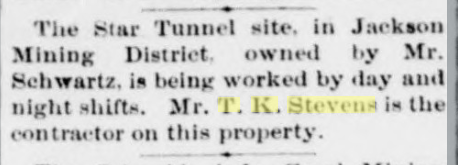
Colorado Mining Gazette - September 23, 1882

Star Tunnel site (lower middle left) - c.1890-1910
Photo courtesy of Denver Public Library Special Collections

Later that year, another dispatch noted: "Mr. Tom Stephens, the old reliable contractor exhibited to the editors of the Gazette a magnificent specimen of gold quartz just received from Nova Scotia during the last days." Apparently, he had maintained links with his Canadian sojourn. The paper also disclosed Thomas' new hobby, announcing that "he bought the Heddenburgh [mine] in Spring Gulch just for fun."

Colorado Mining Gazette - December 9, 1882

Sure enough, among Idaho Springs' land records is a deed dated December 2, 1882 documenting the $200 purchase of the mining claim known as the Heddensburg Lode in the Coral Mining district. Curiously, Thomas bought the lode with his step-father Thomas Mulcrane - the first indication that his mother, Sarah (Kitto) Stephens Mulcrane, was also in the area. 

Excerpt of Thomas K. Stephens and Thomas Mulcrane's
1882 purchase of the Heddensburg Lode

Whether much fun was ever had is uncertain. After Thomas' untimely death, the mine would continue under the operation of his son William John Stevens.

Citizenship, Incorporation, and Wrasslin

In May 1883, Thomas sold to his wife Susan their lots in Idaho Springs. She paid him $700 ($525 more than Thomas paid for the property just ten months earlier). Why was he moving their real estate in her name?

Excerpt of Thomas K. Stephens selling lots to his wife Susan

The following month, Thomas' ancestral heritage was on display. A dispatch from Idaho Springs, published in The Rocky Mountain News, named the winners of the town's Cornish wrestling match. A second place prize of $40 in gold went to Thomas Stevens. It's unclear whether this is Thomas - who was 37 years old - or his son Thomas H. Stephens who was 16. Either way, it's a rare confirmation that a popular cultural activity from their homeland (known colloquially as "wrasslin" in Cornwall, where the form of wrestling originated) was still practiced.

Rocky Mountain News - June 7, 1883

On July 6, 1883, an edition of the Weekly Register Call listed several men, including a Thomas Stevens, who "were granted first naturalization papers by Judge Collier..." Was Thomas working to become a U.S. citizen? These records aren't digitized and are archived in Clear Creek County's courthouse. I'll need to schedule a visit to learn more.

Weekly Register Call - July 6, 1883

The very next day, Thomas began advertising his mining services. T. K. Stephens & Co. were in business as mining contractors offering "Practical Mining in all its Branches" and assured clients they would "Receive Prompt Attention and Thorough Execution." The ads ran through mid-1884.

Colorado Mining Gazette - July 7, 1883

Operating his own business in a risky sector provides context and justification for why he likely applied for American citizenship and moved the family home - their largest asset - to his wife's name. 

Injury amid financial hardship

In a series of peculiar transactions in July 1884, Susan Stephens appeared to be maneuvering her family's assets to pay mounting debts. On July 12th, she mortgaged her lots on Miner Street to Bella Ward for $100. Two days later, Susan used portions of this same property as collateral in a deal with Wilber Horn who paid her $1 (at 10% interest) to satisfy a $65.36 debt on a promissory note to Dennis Faivre, an Idaho Springs grocer (who routinely advertised himself as an agent who sold Sachs, Pruden &  Co.'s famous ginger ale).  

In September 1885, Thomas suffered his first noteworthy injury. While working as a fireman in the smelter for the Plutus mine (site of the former Hukill mine), Thomas "bruised his hand" and was left "laid up". 

Colorado Mining Gazette - September 19, 1885

1890 Sanborn Fire Map, detail of Plutus mine and smelter

The extent of injury to Thomas' hand wasn't clear nor was its impact on his ability to work and earn a living. Despite an insurance policy, it appears Thomas' family continued to struggle with financial hardship. 

A testy blurb in a February 1886 edition of the Colorado Mining Gazette (in which Thomas had advertised his mining services) aired his dirty laundry for their readership: "T. K. Stevens is the name of a gentleman who poked a Gazette at the postmaster marked 'refused'. Mr. Stevens should have done this before his subscription account ran up to $350 - which he still owes at this office."

Colorado Mining Gazette - February 6, 1886

The following month brought some promising news. On March 1, 1886, Susan bought her lots on Miner Street back from Bella Ward. The Stephenses owned their home again.

Unfortunately, the danger of Thomas' work soon reemerged. During the summer, workmen at the Plutus mine were "digging trenches for the air pipe leading from the new compressor, run by water power," and huge blocks of granite were "being dressed down and laid for foundations" (Weekly Register-Call, September 17, 1886). On August 30, 1886, The Rocky Mountain News wrote of an "Accident at the Springs" that was detailed further by the Weekly Register Call:

"A deplorable accident occurred in the Plutus mine on Spanish Bar, above Idaho Springs, yesterday, to a miner named Thomas Stephens, where he had been employed for some time past, by the falling of a mass of rock weighing a couple of tons. Mr. Stevens was caught by the falling mass a little above the hips, inflicting serious injuries, which it is feared will result in death. Dr. Richmond was called from this city [Central City] to attend to the injured man, but entertains little hope for the suffering miner. 
Tom Stevens (sic) has but one hand, the right one, but notwithstanding this, he is considered one of the best miners in the county, and was always in demand by mine owners when he was out of a job. Mr. Stevens is a real estate owner and a very worthy citizen, who has the deep sympathy of every one."

Weekly Register Call - September 2, 1886

We learn for the first time that Thomas had lost his left hand - perhaps in the Plutus smelter accident nearly a year before - and was back in the mines when he was crushed by the rockfall. Despite initial speculation that his injuries would be fatal, Thomas made a rapid recovery during the fall of 1886 under the care of Dr. Richmond.

A strange fatality hovers

In June 1885, the Plutus Mining and Smelting Company of New York purchased the former Hukill mine after its assets were liquidated to pay debts owed to men like Thomas. Seven months later, in January 1886, the Plutus mine, mill, and smelter employed about 100 men and produced about $10,000 in ore each month (Rocky Mountain News, January 25, 1886). Under Plutus, profits for the mine increased $20,000 in its first six months of operation compared to the final six months under Hukill ownership (Rocky Mountain News, January 7, 1886).

Mayflower, Plutus (highlighted), and Salisbury mines along
left side and Hyland mine on right side across Clear Creek
Photo courtesy of Denver Public Library Special Collections

In October 1886, the Colorado Mining Gazette reported "Ninety-five thousand pounds of machinery arrived" for the Plutus mine. This investment included an air compressor that would "do an immense amount of hoisting, besides running fifteen three-inch air drills" (Colorado Mining Gazette, October 9, 1886). The foundations for the compressor were built during the summer, and it was during this work that Thomas was likely injured by falling rock.

Despite the improvements to the mine's operations, it remained dangerous work. On Monday, November 22, 1886, Thomas and his eldest son Thomas H. Stephens were working inside the Plutus mine when disaster struck. Shortly after 6:00 pm, an "unlooked-for and dire accident" occurred and "two men full of life and hope were hurried into eternity; one instantly and the other a few hours later."

Before he succumbed to his wounds, Thomas K. Stephens recounted the chain of events that unfolded as he and his son were setting an explosives charge to blast rock inside the Plutus mine: 

"He and his son had placed a portion of the charge of giant powder at the bottom of the hole and afterwards the fuse and cap, which was followed by more powder, which his son was in the act of pushing home with a tamper made by himself two days previously, of gas pipe with a stick in the tamping end, and thought by himself to be safe, when the explosion occurred" (Colorado Mining Gazette, November 27, 1886).

The coroner determined an inquest was unnecessary because he believed "that the men failed to push the cap and fuse home, and that when they were forcing the last part of the charge home the cap was struck by the tamping bar with sufficient force to explode it, and that if any mis-management or carelessness obtained at all, it was at that time" (Colorado Mining Gazette, November 27, 1886). Local papers ran with this assessment, writing that "T. K. Stevens made a statement a few minutes before his death, fully exonerating the Plutus management from all blame."

When the charge ignited prematurely, the resulting explosion killed the junior Stephens instantly "as he was terribly mutilated." He suffered gruesome wounds to his head, arms and torso. The senior Stephens, who was standing alongside his son, was thrown twenty feet from the stope to the bottom of the drift. He survived, was carried out of the mine and taken to his home on Miner Street where he lingered for nearly eight hours. He suffered a dislocated shoulder, broken leg, and lacerations to his body. The Rocky Mountain News wrote, "Everything was done by the medical attendants and others present to alleviate Mr. Stevens' anguished sufferings, which he bore without a murmur..." At 2:00 am, "death relieved him of his agony" (Weekly Register - Call, November 26, 1886).

The story was picked up by every newspaper in Colorado and many provided readers with graphic details of the injured. 


The Weekly Register-Call observed, "This is the second accident that has happened [to] Mr. Stevens within the past six months. The first he suffered the loss of a portion of his right hand. A strange fatality seems to have been hovering over him." The Rocky Mountain News added that, in addition to being blown up by powder twice, Thomas had "also been twice crushed by falling dirt - the last time about three months since which laid him up till about two weeks ago, when he again resumed work in the Plutus."

Weekly Register-Call, November 26, 1886

A decent interment for the dead miners

The death of Thomas and his son left Susan a widow at the age of 43 with four children to raise (her youngest was three years old and the oldest was 14). The Rocky Mountain News noted that his aged mother, Sarah (Kitto) Stephens Mulcrane, also resided in Idaho Springs.

The Stephens family pictured in the early 20th century
Susan Elizabeth (Day) Stephens is at center with her children

The Colorado Mining Gazette praised Francis Osbiston, the wife of Plutus mine manager Colonel Frank Obiston, who jumped into action and was said to be "indefatigable in her attention to the bereaved family ministering with her own hands to their wants and personally overseeing and procuring the necessary requisites for the decent interment of the dead miners."

The community rallied around the Stephens family. "Several papers have been circulating this week for the benefit of the Stevens family" that resulted in significant fundraising. "Quite a large amount has been subscribed by our citizens for the benefit of the Stevens family" with Campbell & Mason (a local grocer) leading with a $25 donation. There was even talk of organizing an "entertainment for their benefit" that the Colorado Mining Gazette urged, "Let our local talent go to work upon this matter at once. If it is delayed, people will get cold." Mayor Elliott gained the support of the city's aldermen to donate a lot in the cemetery to the family.

The remains of Thomas and his son were prepared for burial by surgeon I. N. Smith who "has one of the tenderest of hearts, and his fingers are as dexterous and careful as those of the best surgeon in the land." His skills were essential considering the grisly injuries. "He was in constant attendance upon the unfortunate Stevens family, alleviating the sufferings of the father and tenderly smoothing the face and body of the poor battered and bruised son" (The Idaho Springs News, November 26, 1886). 

During a funeral at the home, "Very appropriate and consoling remarks were made by the Rev. D. D. Van Antwerp of the Episcopal church." From the house, a "large concourse of friends and well wishers followed the remains to the cemetery, where the bodies of father and son were laid to rest side by side" (The Rocky Mountain News, November 25, 1886). 

A stone obelisk marks the Stephenses' grave. Perhaps Francis Osbiston and the community had a hand in raising funds for the tombstone. The cemetery's logs record Susan Stevens as the purchaser for the family plot. 

An inscription along the base of the stone says:

"Weep not for me oh my wife & children dear,

For I am not dead but sleeping here.

I was not yours but Christ's alone,

He loved me best and took me home."

Memorial to Thomas K. Stephens and his son Thomas H. Stephens
Idaho Springs Cemetery (photo by author)

Epilogue

After the death of her husband and son, Susan raised her four children and never remarried. She died in Idaho Springs in January 1919 having outlived six of her eight children. Her death notice flagged that "It was the express wish of Mrs. Stevens that no flowers be sent for her funeral." She was buried in the family plot and her name was added to the stone obelisk.

The Plutus continued to operate although signs of difficulty emerged. A year after the Stephenses' death, a post in the Colorado Mining Gazette said, "There is no truth in the statements...that the Plutus mine had been sold." In June 1888, the Weekly Register Call reported that two men (W. R. Ireland and John Chavanne) were killed in an explosion in the mine. In January 1891, The Colorado Miner noted "that a miner working in the Plutus mine had his hand badly crushed."

By May 1891, the Plutus mine shut down as it was reportedly "consolidating into new hands in order that it may be developed to its full extent." The Georgetown Courier added that, "When the Plutus mine shut down it had 8 inches of 259 ounce ore in the lowest level. The difficulty seems to be, not with the mine, but that the management is not harmonious. A speedy adjustment of the matter is looked for."

In February 1892, The Rocky Mountain News reported, "The Plutus mine was sold to-day by Sheriff Josiah H. Bell, for the adjustment of the claim of the judgment creditor. The First National Bank was the purchaser, the price paid being $7,422.34." Days later, the Weekly Register-Call confirmed, "A Colorado Springs Mining company has purchased the Plutus mine on Spanish Bar above Idaho Springs. The price paid was $220,000." Reflecting on its glory days, it added, "The mine is well known and at one time was very productive under the management of Col. Frank Osbiston."

During the mid-20th century, interstate 70 was built through Idaho Springs, which changed the town's appearance and obscured obvious signs of the Plutus along Clear Creek. Today, the mining industry is gone. It's easy to overlook the history of the area's mining legacy, but it's there if you're willing to dig a little beneath the surface.

Saturday, April 4, 2020

The Tumult and Trauma of Eva's Life

In a dispassionate summary of her final days, an attending physician wrote that Eva "... was admitted [to the hospital] because she was having severe abdominal pain... Her condition worsened. She expired on May 11, 1972."

Eva, my second great-grandmother, succumbed to ovarian cancer at the age of 86, ending a life marked by unrelenting adversity.

Eva Matilda Adaline Lamb Stevens Fagan

A Wayward Childhood


Born in Vermont in December 1885, she was baptized four months later as Eva Matilda Adaline in a Methodist Church across the border in Quebec, Canada. She was the eldest child of Francis and Phoebe (Jarvis) Lamb.

Eva Lamb's April 1886 Baptism - Methodist Church,
Windsor, Sherbrooke, Quebec, Canada

When his daughter was born, Francis (Frank) Stephen Lamb was a brakeman for the railroad. The young family lived in Island Pond, Vermont, which was situated on the Grand Trunk Railway midway between Montreal and Portland, Maine.

In the 1900 U.S. Federal Census, the Lamb family was enumerated in Denver, Colorado. Curiously, Frank used a modified version of his middle name as his surname (Stephen became Stephens). Family lore said Frank killed a man in Canada and changed his name to evade the law. No evidence has surfaced to corroborate the Canadian murder mystery. However, for the rest of his life, he used this alias.

1900 US Federal Census, excerpt of Frank Stephens family in Denver, Colorado

Frank and Phoebe had a tumultuous marriage. In June 1901, it was punctuated by a violent attack. Frank, suspecting an adulterous relationship, shot a gentleman friend of Phoebe's. The salacious scandal splashed their personal lives across Denver's headlines, left an innocent bystander clinging to life, sent Frank into hiding deep inside a Colorado mine shaft, and shattered the Lamb family (see Till Jealousy and Bullets Do Us Part).


Newspaper accounts included an interview with Eva. She tearfully told a reporter with the Denver Rocky Mountain News that, "Papa and mamma have been quarreling off and on for over two years."

A month after the violent attack, the Denver Post published an article: "Children Gone: Stephens Family Disintegrating at a Rate That Frightens Mother - Stephens Suspected." The article revealed that Eva was now "wayward" and had been sent to the Home for Incorrigible Girls.

Unto My Beloved Wife


Three years after her parents' calamitous quarrel, Eva married William John Stevens.

William, a young gold miner from Idaho Springs, Colorado, had grown up in a mining family. His father, Thomas, was born to a mining family in Cornwall, England, immigrated to Canada and eventually moved to the Rocky Mountains where he was killed in an 1886 mine explosion.

William and Eva (Lamb) Stevens
Photo from the collection of Stevens cousin Amy Goodman

William and Eva settled in Idaho Springs and had two children: Thurlow (born in 1907) and Bernice (born in 1910). But tragedy loomed. Just three months shy of their 12-year wedding anniversary, William died at the age of 36 from mitral insufficiency and Bright's Disease. The contributing causes of death were dropsy and miners disease.

Tragically, William must have known he was dying. In February 1916, one month before his untimely death, he drafted his will. With moving language, he bequeathed his estate and effects "unto my beloved wife, Eva A. Stevens, absolutely; and I appoint her sole executrix of this my will, and guardian of my infant children during their respective minorities."

Excerpt from William Stevens' February 1916 Last Will and Testament

At the age of 30, Eva was a widow with two young children to raise.

Hardships To The End


Eva's medical records indicated that she was afflicted with influenza soon after her husband's passing, perhaps an early victim of the Spanish flu pandemic that swept the world in 1918.

In about 1919, Eva married Thomas Fagan. By the enumeration of the 1920 U.S. Federal Census, the Fagans were living in Denver.

On November 1, 1930, Eva's daughter Bernice married Robert O'Connor. Less than five months later, she gave birth to a daughter named Beverly (my grandmother). Clearly, Bernice was already pregnant when she married Robert. Tragically, one week after the birth, Bernice passed away due to complications. She was only twenty years old.

Five days after Bernice's death, on April 1, 1931, Thomas and Eva Fagan petitioned to adopt Beverly as their own child. A court determined "that consent in writing by said Robert V. O'Connor, sole surviving parent of said child, has heretofore been given to the petitioners herein for the adoption of said child, Beverly Bernice O'Connor..." and a decree granted the adoption, changing Beverly's surname from O'Connor to Fagan.

In later life, Beverly shared that, during the Great Depression, she spent her early childhood living in a tent city while Thomas Fagan worked on the construction of Hoover Dam. She wrote in her journal that Eva "was very mean to Grandpa [Thomas] and I never knew why. I realized that Grandpa was drinking then the fights would start."

Thomas passed away in August 1950, once again leaving Eva a widow. She was 64 years old.

A decade later, in January 1961, her son Thurlow passed away from a sudden heart attack. Eva had outlived her last surviving child.

A Quiet Repose


In her final years, Eva lived alone in a mobile home in a Denver trailer park.

Eva pictured standing outside her mobile home

She was close with her granddaughter Beverly and her young family. She cooked and had a special knack for baking breads, especially wheat and rye. She busied herself gardening in the small yard in front of her trailer, and sewing clothes for her great-grandchildren who all remember her affectionately.


Eva in a rare film clip, 1957

One could mistake her serene golden years for a life happily lived, but, in reality, that facade belied its true churning turbulence.

Eva's childhood was fraught. She lost her first husband. She outlived her daughter and raised her granddaughter as her own child. She lived in poverty with an alcoholic husband and outlived him. Then, the final injury, she lived through the sudden death of her son - her last living child.

Indeed, Eva lived a life of tumult and trauma.

Perhaps that's why she refused to ever discuss the past with Beverly. Forgetting was a coping mechanism. Forgetting allowed Eva to move beyond the incessant heartaches and survive in a world that had dealt her an exceedingly heavy hand.

Friday, August 3, 2018

A Felled Genealogy Brick Wall Paves the Way to Cornwall

Over four years ago I wrote about my third great-grandfather Thomas K. Stevens who was killed in a grisly mining accident.

Born in England in 1845 and married in Nova Scotia in 1868, he worked in Colorado's mines until his untimely death in 1886.

I knew a fair amount about his life in North America, but who were his parents? I was at a loss.


A newspaper account reporting his death noted that he had an "aged mother who also resides" in Colorado, but she wasn't enumerated with his family in the 1880 census and, well, we all know what happened to the 1890 census. I couldn't identify a candidate who met his mother's profile.

Like his wife Susan Day, Thomas' parentage was unknown. My Stevens family line was stuck at a seemingly insurmountable brick wall yielding few clues.

My research attention turned elsewhere and the Stevens mystery sat neglected. For years. Until earlier this month...

Brotherly Love Goes Digital


While writing about my most recent immigrant ancestors, I profiled Thomas' son, my second great-grandfather, William John Stevens. Reacquainting myself with the Stevens family prompted me to reevaluate the evidence gathered. I've learned a lot in the past four years about genealogy dos and don'ts and there were a lot of very loose ends left unexplored with the Stevens line.

In 1880, Thomas' first appearance in a US Federal Census that I was aware of, showed that he and his wife Susan along with their four children were living in Idaho Springs, Colorado with his brother Richard and his wife Matilda.

1880 US Federal Census: Idaho Springs, Clear Creek, Colorado

Curiously, the census noted that Thomas was "Maimed, Crippled, Bedridden, or otherwise disabled." Had there been a mining accident in Newfoundland - where the family was last documented before Colorado - that necessitated a move to be with his family?

The census indicated Thomas was born in England as were both of his parents. His brother Richard, though, was a different story. Like Thomas, Richard's parents were both born in England. Unlike Thomas, Richard was born in Wisconsin. Aged 23 in 1880, Richard would have been born in the Badger State in about 1857.

Was I understanding this correctly: the Stevens brothers' - or at least Richard - were in Wisconsin in the mid-19th century?

Clearly, I needed to examine Richard more closely.

I quickly learned that sometime after the 1880 census, Richard and his wife Matilda left Colorado for Iowa where they appeared on that state's 1895 census. In 1902, Matilda passed away leaving Richard a widower.

Five years later, an Iowa marriage register (recently digitized) recorded the nuptials between Richard and Sarah Parish. The later-in-life wedding was quite fortuitous because Iowa began documenting the parents of both the bride and groom.

Excerpt from 1907 Iowa marriage register

Richard's second turn at love gave me his parents' names: Henry Stevens and Sarah Kitto.

These were also quite possibly Thomas' parents and my fourth great-grandparents. My only hesitation was whether either parent had died and the other remarried resulting in the brothers actually being half-siblings. But with names in hand, perhaps I could answer that question.

Tracing Family to England's Land's End


I searched Ancestry's online database of English marriages dating back to 1538, and struck gold. A text-only transcription detailed a marriage between Henry Stephens and Sarah Kitto that was solemnized on April 20, 1844 in the village of Breage, Cornwall.

To my great delight, FamilySearch had digitized the parish registers, including the Stephens-Kitto wedding. After trawling through the unindexed images, I found what I was after.

Stephens-Kitto marriage in Breage, Cornwall, England April 20, 1844

The marriage record also provided the names for Henry and Sarah's fathers, my fifth great-grandfathers: Henry Stephens (Sr.) and John Kitto. The family tree was in full bloom.

Knowing that Thomas K. Stevens was born in 1845, I began paging through dozens of baptism records. At last, there he was!

My third great-grandfather Thomas Stevens/Stephens was baptized on November 21, 1845 in Breage, Cornwall. Like his brother Richard, he was the son of Henry and Sarah (Kitto) Stephens.

Thomas Stephens baptism in Breage, Cornwall, England November 21, 1845

The English marriage and baptism records were just the beginning. I now have an entire branch of my family tree rooted in Cornwall, and wonderfully comprehensive church records are helping me bring them back to life. There's plenty to keep me busy for the foreseeable future.

In the meantime, I think I'll savor this discovery. Excuse me while I binge-watch the British historical television drama Poldark, and imagine my ancestors living in the beautiful Cornish landscapes!

Saturday, July 14, 2018

Immigrant Ancestors: Newfoundland to Colorado

All eight of my great-grandparents were born in the United States.

Climb back just one more generation, however, and we meet my most recent immigrant ancestors: three second great-grandparents.

The earliest of these three to arrive in the US was William John Stevens, who immigrated with his parents as a baby.

William John Stevens


William John Stevens

The 1880 US Federal Census enumerated a one-year-old Willie, his three older siblings, and their parents (my third great-grandparents) - Thomas and Susan (Day) Stevens - living with Thomas' younger brother Richard in Idaho Springs, Colorado.

It appears that the family emigrated from Newfoundland (well before it would become part of Canada in 1949) to Colorado shortly after William's birth.

William's death certificate corroborates his birth in Newfoundland and gives his exact birth date as March 29, 1879.

William John Stevens death certificate extract

The Stevens family's move must have happened sometime between William's birth date and June 1, 1880 when the US census was enumerated.

The 1880 census illustrates that the Stevens family was mobile within the soon-to-be Canadian territories before immigrating to the US.

We learn that the Stevens patriarch, Thomas, was born in England in about 1845. His wife, Susan Elizabeth (Day) Stevens, was born in about 1843 in Nova Scotia. Their first three children were each born in Nova Scotia. Willie, though, was the first and only to be born in Newfoundland.

1880 US Federal Census enumerating the Stevens family in Idaho Springs, Colorado

Geographically, the move from Nova Scotia to Newfoundland is the opposite direction from the United States. What could have motivated the family's peculiar route? Work opportunities, I assume.

A Wandering Path


Migration paths can be difficult to trace during this time period, but the clues - however faint - exist. A couple additional hints about the family's migration path come from this census and William's death record.

First, the birth place for Thomas' brother, with whom the family was living, was enumerated as Wisconsin. It would seem that my fourth great-grandparents had immigrated from England to Wisconsin. I don't currently know their identities.

Second, William's death certificate mistakenly states that his father Thomas was born in Michigan. Was Michigan on the informant's brain because the family lived in the state for a time between Newfoundland and Colorado? Was Michigan their entry point from Canada to the United States?

And Miles To Go


I would love to learn more about the immigration story of my third great-grandfather Thomas K. Stevens, which apparently included a trans-Atlantic voyage and then an overland trek across half the North American continent.

Born in England in about 1845, there should be a civil record of his birth that would shed light on his parents' identities.

What prompted him to sail from England to Nova Scotia? Did he also make the journey with his parents as a child like William, or did he journey alone as a young adult?

Immigration stories are fascinating windows into our ancestors' journeys for new opportunities and a better life. Clearly, courage and persistence were required to undertake a move in an era when transit was a time-intensive labor and what awaited you at your destination was uncertain. It's an endeavor for which I have great admiration.

Who were your most recent immigrant ancestors? Have you retraced their journey?

Sunday, January 26, 2014

52 Ancestors: #4 Bernice Myrtle Stevens O'Connor

My grandmother never knew her birth mother Bernice. Grandma told me befuddling stories about how her one-time uncle became her brother and grandparents became parents. The concept sounded to me like a twisted Shakespeare plot.

As I researched Bernice's life, I was struck by its brevity and, throughout, the youthfulness at the core of each hardship.

Bernice Myrtle Stevens, my great-grandmother, was the second child of William John Stevens and his wife Eva. She was born in July 1910 in Idaho Springs, Colorado.

In March 1916, her father passed away at the age of 36. Bernice was only five years old. Sometime before the 1920 Federal Census, her mother Eva remarried to Thomas Augustus Fagan. In that census, Bernice is listed as the 9 year-old step-child of Thomas along with her brother Thurlow. The family had moved from the mountains of Clear Creek County to Denver.

1920 Federal Census - Denver, Colorado

As early as 1927, when she was only 17, Bernice appears as a working girl in Denver city directories. Her occupation is given as phone operator. She appears again in the 1929 directory with the same position. I can imagine her connecting calls on a towering switchboard - a teenager mastering the new technology of the day.

City of Denver 1927 Directory
In the 1930 census, she's still living at home with her parents and brother. However, we learn that she's landed a new job. She's working as a sales lady at a candy store.

1930 Federal Census - Denver, Colorado

On November 1, 1930, Bernice married Robert V. O'Connor. Less than five months later, she gave birth to a daughter. Clearly, she was already pregnant when she married Robert. Tragically, one week after the birth, Bernice passed away due to complications. She was only twenty years old.

Shortly afterwards, Bernice's daughter, my grandmother, was adopted by Eva and Thomas Fagan. The once grandparents became parents, and Uncle Thurlow became a brother. I speculate that a formal adoption was initiated so Eva and Thomas Fagan could legally keep and raise their daughter's child.

After her passing, Thomas Fagan made a gravestone for Bernice. For years, Eva would visit the burial with my grandmother and hold emotional vigil. Once, after Eva had passed away, my grandmother returned to visit the grave. The original handmade marker was gone. When she inquired with the cemetery management, she was told that it didn't meet new restrictions on grave stones and was subsequently removed. The cemetery did not have up-to-date contact information for next of kin, so no family was notified. My grandmother promptly commissioned a new marker, which rests on Bernice's grave today and serves as commemoration of her short life.

Sunday, January 19, 2014

52 Ancestors: #3 William John Stevens

William John Stevens, my second great-grandfather, was the fourth of five children born to Thomas K. Stevens and Susan Elizabeth Day.

According to his death certificate and the 1900 US Federal Census, William was born March 29, 1879 in New Foundland, Canada. I haven't had success in locating a birth record. FamilySearch boasts an extensive collection of vital records from the time period. Unfortunately, they're not indexed and I don't know in which parish or district he was born. I'm hopeful a birth record will soon surface from my time-intensive document trawling.

William John Stevens - February 1916 Will and Testament
William passed away quite young; he was only 36 years old. Tragically, it appears he knew he was dying. In February 1916, one month before his death, William drafted his will. It's moving to read how he bequeaths his estate and effects "unto my beloved wife, Eva A. Stevens, absolutely; and I appoint her sole executrix of this my will, and guardian of my infant children during their respective minorities."

The cause of death was a frightening (yet archaic) combination of mitral insufficiency and Bright's disease, both complicated by protracted "Dropsy miner's disease." William was buried in Idaho Springs in the cemetery where his father and older brother were already interred. His mother, Susan, outlived both her husband, William and two other children.

From his will and death certificate, I've learned that William operated a plumbing and drainage business (which he also left to his wife Eva). But the cause of death "Dropsy miner's disease" suggests that, like his father before him, he was also a miner for some time. I wonder if symptoms from miner's disease began to appear and prompted him to change his profession, but too late?

I can only speculate. Regardless of the cause, his untimely passing was tragic - leaving his widow to raise two young children, including my great-grandmother Bernice Stevens.

Sadly, the family's tragedy would continue. We'll pick that story up next week.